
The Best Bird Feeder Cameras of 2026
Feature photo: Jaymi Heimbuch

This post contains affiliate links. If you use these links to buy something, we may earn a commission at no additional cost to you. We only recommend products we fully support or use ourselves. Our full disclaimer
PIN THIS FOR LATER
Contents
The first time a bird showed up at our feeder that we genuinely did not know visited our yard, we were hooked. It was a Black-headed Grosbeak and we saw it not at the window, but on our phone via a notification, looking at a sharp close-up photo with a species ID attached.
That is what a bird feeder camera does that nothing else really can.
It encourages you to spend even more time looking out the window when you're home, and staying curious about your bird-y neighbors when you're away.
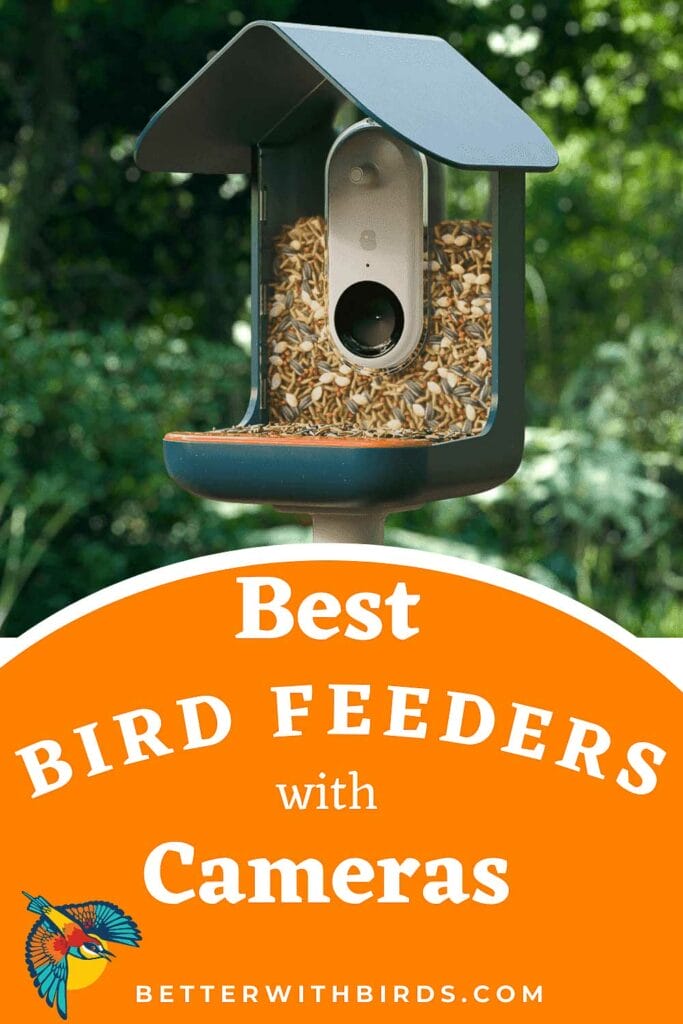
A bird feeder camera is a feeder with a built-in camera that triggers when a bird lands. Most models send photos or video clips straight to your phone, with AI that identifies the species for you. You see individual feather detail, feeding behavior, and birds you would have missed entirely.
This market has grown fast over the past year, with better cameras, new brands, and features like multi-lens systems and birdsong identification.
We've been testing bird feeder cameras for over three years and keep close tabs on what is new. Below are our top picks based on hands-on testing and thorough research, plus what to look for when shopping and a DIY option if you would rather build your own.
Best Bird Feeder Cameras Compared
| Feeder | Best For | Resolution | AI Bird ID | Power | Storage |
|---|---|---|---|---|---|
| Bird Buddy | Best overall | 5MP / 1080p video | Yes (free) | Battery + solar option | Cloud (Wi-Fi required) |
| Netvue Birdfy | Most versatile | 1080p | Yes (AI model) | Battery + solar option | MicroSD + cloud |
| Birdfy Feeder 2 Duo | Best premium | 2K + 1080p + side HD | Yes (free, 6,000+ species) | Solar + 9,000mAh battery | Cloud (30-day retention) |
| isYoung | Best night vision | 2.5K QHD | Yes (free, 16,000+ species) | Dual solar + battery | Cloud |
| Harymor | Best value | 2K | Yes (10,000+ species) | Triple solar + battery | Cloud |
| Soliom | Best budget | 2K | Yes | Solar + battery | Cloud (Soliom app) |
Our Top Picks
Over the past year of testing, our feeders have attracted Chestnut-backed Chickadees, Red-breasted Nuthatches, Spotted Towhees, Dark-eyed Juncos, Steller's Jays, Pine Siskins, Black-headed Grosbeaks, American Goldfinches, House Finches, Purple Finches, and even a small flock of Red Crossbills — an irruptive species we almost certainly would have missed without the motion alerts. We've also had hummingbirds visit regularly when hummingbird add-ons were tested, which changed how we evaluated cameras with dedicated hummingbird features.
1. Bird Buddy: Best Overall
Features
- 5MP camera with wide dynamic range
- 720p to 1080p video
- 120-degree field of view
- AI bird species recognition (free)
- Real-time visit notifications via app
- Rechargeable battery with solar roof option
- Weather-resistant housing
- Cloud storage (Wi-Fi required, no local storage)

Photo: Jaymi Heimbuch
What We Think
The Bird Buddy is our top pick after six months of side-by-side testing. The 5MP camera captures sharp, detailed images, and the 120-degree field of view means you're not missing birds that land slightly off-center.
The AI species identification works well. It's not perfect (it occasionally confuses similar species like House Finches and Purple Finches), but it gives you the option to correct misidentifications, and it learns over time. If you enjoy using Merlin Bird ID, you'll feel right at home.

Photo: Jaymi Heimbuch
Battery life runs 5-15 days depending on traffic, but the solar roof option eliminates charging entirely. We went months without thinking about the battery once the solar panel was installed.
The community aspect is a genuine differentiator. The app lets you share photos, see what's visiting feeders worldwide, and invite family members to your feeder's feed. We tested the invite feature with family and it became a fun daily conversation starter.
The main limitation: there's no local storage. You need Wi-Fi for the feeder to function, and all photos and videos are cloud-based. If your yard doesn't have reliable Wi-Fi coverage, this isn't the right choice.
One quirk worth knowing: birds sometimes land on the side or back edge of the seed tray and barely register on camera. A few people in the Bird Buddy community have designed small clip-on fences for the tray that guide birds to land front and center. If you have a 3D printer, it is worth searching for on places like MakerWorld -- it makes a noticeable difference in how many visits you actually capture well.
For those wanting even more, the Bird Buddy Pro subscription adds better image quality, increased cloud storage, and Frenzy mode for higher notification frequency.
Read our full Bird Buddy review for the deep dive.
2. Netvue Birdfy: Most Versatile
Features
- 1080p video resolution
- AI species recognition (6,000+ species)
- Real-time bird arrival notifications
- Modular design with add-on accessories (Hummee, Pro Perch)
- Rechargeable battery with optional solar panel
- MicroSD and cloud storage options
- Live video streaming
- 30-day bird visit history

Photo: Jaymi Heimbuch
What We Think
The Netvue Birdfy has a wider perch than the Bird Buddy, and that one difference changes what you see. When a flock of chickadees or crossbills shows up, multiple birds land at once, and you get actual social behavior -- jostling, interacting, the whole flock dynamic -- instead of one bird at a time. It is genuinely fun to watch in a way a small-perch feeder just cannot deliver.
Battery life is excellent. We charged it roughly once every month or two during heavy use, and the optional solar panel eliminates that entirely. The AI recognition identifies over 6,000 species and sends real-time notifications when birds arrive.
The camera quality is the main trade-off. It's acceptable for identification and general watching, but the images aren't as sharp as Bird Buddy's. You'll notice some artifacting and chromatic aberration (odd color fringing at the edges of objects). If photo quality is your top priority, Bird Buddy wins. If you want the most versatile feeder setup with the best battery life, Birdfy is the choice.

Photo: Jaymi Heimbuch
Storage is more flexible than Bird Buddy: you can use a microSD card for local storage or save to the cloud. Having both options is a real advantage.
The Birdfy Lite model skips AI recognition and the add-ons if you want to save money. You still get solid video quality and great battery life.
Birdfy has also expanded their lineup significantly. See the Feeder 2 Duo below for their premium option, and keep reading for what's coming next.
Read our full Netvue Birdfy review for the deep dive.
3. Birdfy Feeder 2 Duo: Best Premium
Features
- Triple-lens system: 2K rotating/tracking lens + 1080p wide-angle + side HD camera
- AI species recognition (6,000+ species, free, permanent)
- CES 2025 Innovation Award winner
- 9,000mAh battery with solar panel
- IP66 weather-resistant
- Unlimited cloud storage (30-day retention)
- Live streaming from multiple angles
- Operating range: 14°F to 113°F
What We Think
The Birdfy Feeder 2 Duo is the most advanced bird feeder camera on the market right now, and the triple-lens system is more useful than it sounds on paper. In practice, if a bird lands slightly out of frame from one angle, it is almost certainly in frame from another.
But the more interesting thing is what those different angles reveal.
Because you are seeing the same bird from genuinely different perspectives at the same time, you catch behavioral nuances you would never notice from a single camera -- the way a bird positions its body, what it does with its feet, how it interacts with whatever is next to it. It adds a layer to watching that a single-angle feeder just cannot give you.
Where every other feeder gives you one camera angle, the Duo gives you three: a 2K rotating lens that tracks birds as they move, a wide-angle 1080p lens for context, and a side-mounted HD camera for a completely different perspective.
The 9,000mAh battery paired with a solar panel means you're rarely thinking about power. AI identification covers 6,000+ species with no subscription required, keeping ongoing costs at zero.
The main drawback is the price tag. This is a premium product and costs significantly more than any other feeder camera on this list. If you want the absolute best footage and don't mind the investment, the Duo delivers. If you're happy with a single camera angle (which is honestly all most people need), the original Birdfy or Bird Buddy will serve you well for less.
Read our hands-on review of the Duo here.
4. isYoung: Best Full-Color Night Vision
Features
- 2.5K QHD resolution
- 170-degree field of view
- AI species recognition (16,000+ species, lifetime free)
- Dual solar panels (5W total)
- 5,000mAh removable battery
- IP65 weatherproof
- AI auto-capture and motion detection
- Full-color night vision
What We Think
We haven't tested this one personally. Our take is based on verified purchase reviews and specs.
The isYoung's standout feature is full-color night vision. Most feeder cameras flip to grainy black-and-white infrared after dark; the isYoung keeps color, which makes it far more useful for the low-light dawn and dusk visits when a lot of feeder activity actually happens. Pair that with 2.5K QHD resolution and a 170-degree view and you get sharp, true-color footage across more of the day than most cameras on this list.
The AI claims 16,000+ species with lifetime free access, which means no subscription fees. That's the most generous AI offering on this list. In practice, reviewers report it correctly identifies most common backyard species, though like every feeder camera AI, it struggles with visually similar birds. One quirk worth knowing: the AI identification only works during live view, not on recorded playback.
Dual solar panels and a removable 5,000mAh battery keep things low-maintenance. The removable battery is a nice touch. Instead of bringing the whole feeder inside to charge, you can just swap the battery.
If you want true-color footage day and night without stepping up to the Birdfy Duo's price tag, the isYoung is worth a hard look.
5. Harymor: Best Value
Features
- 2K resolution with 120-degree wide-angle lens
- AI species recognition (10,000+ species)
- Triple solar panels (two built-in roof panels + one external panel)
- 5,200mAh battery
- 2L large-capacity seed tray
- IP waterproof design
- Instant arrival alerts via app
- Motion detection with adjustable sensitivity
What We Think
The Harymor has quietly become one of the best-selling bird feeder cameras on Amazon, and the price-to-feature ratio explains why. You get 2K resolution, AI bird identification, and triple solar panels at a fraction of what Bird Buddy or Birdfy charge. With over 1,400 Amazon reviews, it has the largest user community of any feeder camera on the platform.
The triple solar setup is genuinely clever: two panels are built into the roof and a third external panel provides backup power. In most climates, this keeps the 5,200mAh battery topped off indefinitely without intervention.
The 2L seed capacity is generous and reduces refill frequency. The camera streams 2K video to the Vico Home app (a third-party app also used by other smart home devices), and motion detection sends instant alerts when birds arrive.
There's a trade-off, though: AI accuracy is hit-or-miss. Reviewers report the Harymor occasionally suggests birds that don't exist in your region. It handles common species like cardinals, blue jays, and sparrows well enough, but don't rely on it for tricky identifications. Treat its suggestions as a starting point and confirm with a field guide or the free Merlin Bird ID app.
The other limitation: the Harymor must be pole-mounted on a flat surface. It can't hang from a hook or branch like traditional feeders, which may limit placement options depending on your yard.
If you want a smart feeder with AI and solar power without the premium price tag, the Harymor is hard to beat.
Psstt... this one is still in testing in the back yard... more details and photos soon!
6. Soliom: Best Budget
Features
- 2K HD live view
- AI bird species recognition
- Solar panel with rechargeable battery
- Squirrel-proof metal housing
- Instant arrival alerts via the Soliom Pro app
- Ships as a complete bird-watching gift set
What We Think
The Soliom is the one to grab if you want a smart feeder camera for the least money without dropping all the way down to a no-frills trail cam. It regularly sells for less than the Bird Buddy or Birdfy, and it still covers the basics most people actually want: 2K live view, AI bird ID, solar power, and app alerts when something lands.
What sets it apart at this price is the build. The housing is metal rather than plastic, so it stands up to squirrels far better than most budget feeders. The solar panel keeps the battery topped off in most climates, so you are not bringing it inside to charge.
The trade-offs are what you would expect from a value pick. The Soliom Pro app is more basic than Bird Buddy's, and some users find it less polished. AI accuracy is good on common backyard birds but, like every budget feeder, it can stumble on lookalikes. Treat the IDs as a starting point and confirm tricky ones with the free Merlin Bird ID app.
If your main goal is to start watching your feeder without spending premium money, the Soliom gets you there with a tougher build than most of its price-mates.
The DIY Route: Build Your Own
If you already own a security camera or trail camera, you can turn it into a bird feeder camera with a housing like the Wasserstein Bird Feeder Case, which is compatible with Blink, Wyze, and Ring cameras.
Good security camera options for this include:
- Wyze Cam Outdoor v2: 1080p HD, night vision, two-way audio, battery-powered. Works with Alexa and Google Assistant.
- Blink Outdoor Camera 4: Weather-resistant, motion detection, infrared night vision, two-way audio. Two-year battery life.
- Ring Stick Up Cam: 1080p HD, night vision, motion alerts. Battery, plug-in, or solar power options.
Trail cameras work too. The Wingscapes BirdCam is designed specifically for bird photography with 42MP resolution and a 70-foot detection range.
The DIY approach costs less and gives you more control, but it requires some setup time and doesn't include bird-specific features like AI species identification or dedicated companion apps.
Are Bird Feeder Cameras a Good Gift?
A smart feeder is one of those gifts that reliably lands. You set it up, and a few days later the person you gave it to is getting little photo alerts every time a chickadee or cardinal stops by. It turns an ordinary window into something they check the way you'd check on a favorite show. You don't have to be a serious birder to love it, and most of these set up in about ten minutes with no tools.
Here's how we'd match a camera to the person you have in mind:
- For someone new to it all: the Bird Buddy. Most beginner-friendly, the app handles the bird ID for you, and it feels polished right out of the box.
- For the gadget lover: the Birdfy Feeder 2 Duo. Dual lenses, sharp video, and plenty to keep a tinkerer happy.
- For a parent or grandparent: the NETVUE Birdfy. Simple app, night vision, and a live view that's easy to pull up on a phone.
- For a thoughtful gift on a budget: the isYoung or HARYMOR. Both punch above their price and still do AI bird ID.
What to Look For in a Bird Feeder Camera

Photo: Jaymi Heimbuch
If none of our picks are quite right, here's what matters when evaluating any feeder camera:
- Image quality: Look for at least 1080p video resolution. 2K and 2.5K options are now common and deliver noticeably sharper footage. Higher megapixel counts help with still photos, but video resolution matters more for watching behavior.
- Motion detection: All feeder cameras should have this. Better models let you adjust sensitivity so you're not getting triggered by wind-blown leaves.
- Power source: Battery-only models need regular charging. Solar options are worth the extra cost for set-it-and-forget-it convenience. Look for models with solar panels included rather than sold separately.
- Storage: Cloud-only (like Bird Buddy) requires reliable Wi-Fi. MicroSD gives you a backup. Having both options is ideal.
- AI bird identification: Fun and educational, but accuracy varies widely between brands. Free apps like Merlin Bird ID often do a better job. Don't pay a premium for AI if it's the only reason you're upgrading, and check whether AI requires a subscription or is included for life.
- Weatherproofing: Non-negotiable. Check the IP rating and make sure it's rated for your climate.
- Night vision: Nice to have for catching raccoons and other nighttime feeder raiders, but birds won't be visiting after dark. Full-color night vision (available on some newer models) is a step up from standard infrared.
- App quality: Read app reviews before buying. A great camera paired with a buggy app creates a frustrating experience.
- Subscription costs: Some feeders include AI and cloud storage for free. Others charge monthly fees that add up over time. Factor ongoing costs into your decision, not just the sticker price.

Photo: Jaymi Heimbuch
What About Bird House and Bird Bath Cameras?
Bird house cameras give you an intimate view of nesting behavior, from egg laying through fledging. Bird bath cameras capture birds at their most playful and relaxed. Both are available as purpose-built products or as DIY setups using the security cameras mentioned above.
These are niche products, but if you're already hooked on feeder camera footage, a nest box camera is the natural next step.
Frequently Asked Questions
Common questions about bird feeder cameras, answered.
Do bird feeder cameras scare birds away?
No. The cameras are integrated into the feeder housing, so birds don't perceive them as a threat. Most birds acclimate to a new feeder within a few days regardless of whether it has a camera.
Do I need Wi-Fi for a bird feeder camera?
It depends on the model. Bird Buddy requires Wi-Fi since it's cloud-only. Most feeder cameras (Birdfy, isYoung, Harymor) need Wi-Fi for live streaming and notifications but may also support local microSD storage. If your feeder location doesn't have reliable Wi-Fi coverage, choose a model with local microSD storage as a backup.
How long do the batteries last?
It varies widely. Bird Buddy lasts 5-15 days on a charge. Birdfy goes 1-2 months. Adding a solar panel to any compatible model essentially eliminates the need to think about battery life. The Harymor's triple solar setup and the isYoung's dual panels are particularly good at keeping things self-sufficient.
Will squirrels damage the camera?
Squirrels will try. Plastic feeder cameras can get chewed if squirrels are persistent. For any feeder camera, a squirrel baffle on the mounting pole is a smart investment.
Is AI bird identification accurate?
It's good enough to identify most common backyard species correctly. Expect accuracy in the 80-90% range for straightforward species, with more misidentifications among similar-looking birds (sparrow species, for example). Bird Buddy tends to be the most accurate. Budget options like Harymor may suggest species that don't exist in your region. All the AI models we've encountered allow you to correct misidentifications, and free apps like Merlin Bird ID make a great backup.
Are subscription fees required?
It depends on the brand. Several feeder cameras now include AI and basic cloud storage with no subscription: Bird Buddy (basic tier), Birdfy (AI model), isYoung, and the Birdfy Duo all include lifetime AI at no extra cost. Others charge monthly fees for AI or extended cloud storage. Always check the ongoing costs before buying.
How much do bird feeder cameras cost?
Smart bird feeder cameras range from about $99 on the budget end (Soliom, Harymor) to $329 for premium multi-camera systems like the Birdfy Feeder 2 Duo. Most quality picks land between $150 and $250. Watch for sales: Bird Buddy and Birdfy both run frequent promotions that bring premium models down to the mid-range price point. Factor in $30–80 for accessories: a squirrel baffle pole, replacement seed, and possibly a chew-proof solar cable.
Are bird feeder cameras worth it?
For most backyard birders who want close-up footage of who's visiting and which species are coming through, yes. The footage you'll get from a $150–250 feeder camera is genuinely different from anything you'd see at the window. AI bird identification turns it into a learning tool, and you'll spot species you didn't know visited your yard. They're less worth it if your yard already gets minimal traffic (the camera won't change that), if you have unreliable Wi-Fi, or if you're not interested in app-based notifications. For dedicated birders, they pay for themselves in the species log alone.
The species that surprise you are the ones that stick with you. We had a small flock of Red Crossbills pass through -- an irruptive species that showed up, worked the feeder for a few days, and moved on. We would not have known they were there without the motion alerts. That is the thing about a bird feeder camera: your yard is busier than you think, and now you get to see it.
Whether you go with a smart feeder, build your own, something unexpected is coming to your feeder. You just have to be watching.
For more on getting started with backyard birding, check out our guide to identifying the birds in your yard.