

What Do Bluebirds Eat? Bugs, Berries, and How to Attract Them

This post contains affiliate links. If you use these links to buy something, I may earn a commission at no additional cost to you. I only recommend products I fully support or use myself. My full terms
Contents
Bluebirds eat insects and spiders for most of the year, and they catch the bulk of them on the ground: grasshoppers, crickets, beetles, caterpillars.
Once bugs thin out in fall and winter, they switch to wild berries and other fruit. Birdseed barely registers with them, which is why the food that works at a feeder is mealworms.
That matters if a bluebird is the bird you've been hoping to see from your kitchen window. Even mealworms only go so far. The bigger draw is a nest box in open, short grass, with a low perch nearby where a bluebird can sit, watch the ground, and drop onto whatever moves.
The numbers behind the diet come from a classic stomach study, published in 1915 by F. E. L. Beal, a biologist with the USDA's Bureau of Biological Survey.
Beal's sample held 855 Eastern Bluebirds collected across every month of the year, and about two-thirds of their food was insects, spiders, and other small invertebrates.
Fruit swung hard with the seasons. None of the 58 birds collected in May had eaten a scrap of it, yet by December wild fruit made up more than half the diet.
The two western species leaned even harder on animal food, at about 82 percent for Western Bluebirds and close to 92 percent for Mountain Bluebirds, the highest share of any thrush the study covered.

A male Eastern Bluebird on a low post, the kind of perch it hunts from. Photo: Alex Galt/USFWS (public domain)
Meet the three bluebirds (and where they live)
Bluebirds live only in North America, where there are three species: the Eastern, Western, and Mountain Bluebird. Which one you might see depends on where you live.
| Bluebird | Where it lives | Nest box entrance hole |
|---|---|---|
| Eastern Bluebird (Sialia sialis) | East of the Rockies, southern Canada to Nicaragua. Year-round in much of the South; northern birds mostly migrate. | 1-1/2 inches |
| Western Bluebird (Sialia mexicana) | Much of the western US, southwestern Canada, and Mexico, in open woodland. Resident in some southern areas, migratory in the north. | 1-1/2 or 1-9/16 inches |
| Mountain Bluebird (Sialia currucoides) | High elevations and northern latitudes across the West, to Yukon and Alaska, in open country. Migrates, returning very early in spring. | 1-9/16 inches |
In Oregon, Mountain Bluebirds breed commonly east of the Cascade summit, but on the west side they nest only locally, above about 3,500 feet and in the higher Siskiyous.
Western Bluebirds are most abundant in the low- to mid-elevation foothills of western Oregon. They're common in the Rogue and Umpqua valleys and fairly common on the south coast.
All of that comes after a steep decline in the state, even though numbers across the species' whole range held steady from 1966 to 2019.
I've seen a Western Bluebird in Oregon exactly once, just outside Eugene. I was driving through, and it was just hanging out, a lovely spark of blue. I've never seen one in my yard or around my town on the coast, but I've never gone looking, either. Now I want to.

A male Western Bluebird, rusty breast and blue throat, photographed in Oregon’s Deschutes National Forest. Photo: Dave Menke/USFWS (public domain)

A male Mountain Bluebird, sky blue with no orange anywhere. Photo: Gannon Castle/USFWS (public domain)
What bluebirds eat through the year
From spring into fall, bluebirds live on insects and other small invertebrates. When insects get scarce, from late fall into early spring, they shift to wild fruit.
If you go looking for bluebirds, that calendar is your map: open, short grass in the warm months, and trees and shrubs still holding fruit in winter.
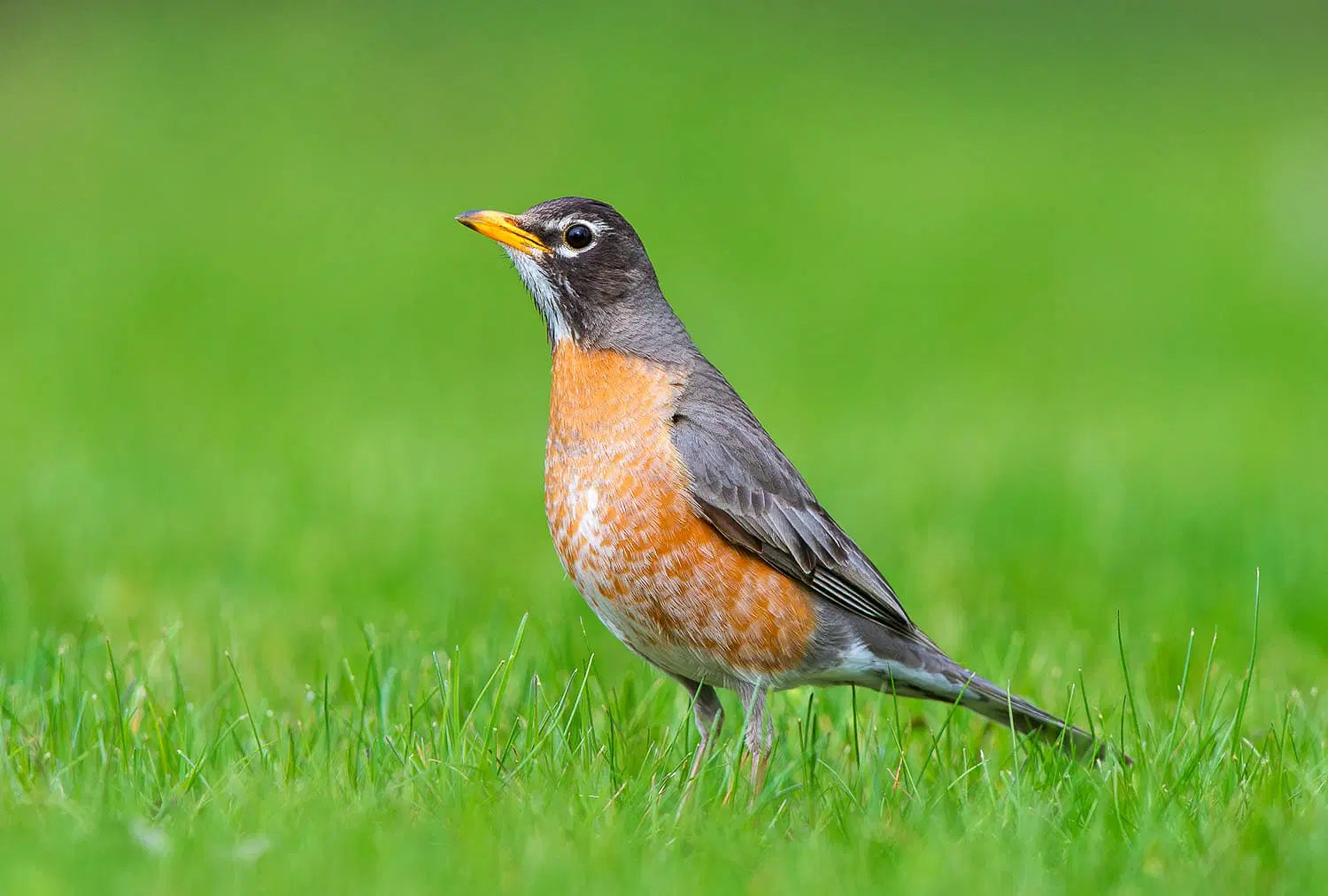
Like the American Robin, bluebirds are thrushes, and Beal's 1915 study covered both. The robin's side of the story is in what American Robins eat.
Measured by volume, the yearly shares in the 1915 study break down like this:
| Eastern Bluebird | Western Bluebird | Mountain Bluebird | |
|---|---|---|---|
| Stomachs examined | 855 | 217 | 66 |
| Animal food (insects, spiders, and kin) | 68% | About 82% | About 92% |
| Plant food (mostly fruit) | 32% | About 18% | About 8% |
| Biggest animal foods | Grasshoppers, crickets, and katydids (22%); beetles (21%); caterpillars and moths (10%) | Beetles (24%); grasshoppers (21%); caterpillars (20%) | Beetles (30%); grasshoppers and crickets (23%); caterpillars (14%); ants (13%) |
Most of the Western birds in that study came from California. The Mountain sample is small, just 66 birds, so read its numbers as a sketch.
Insects in spring and summer
Insects made up about five-sixths of the Eastern Bluebird's food in spring and early summer, according to the 1915 study.
By late summer grasshoppers and crickets had taken over, and in August and September they were more than half the diet. If grasshoppers scatter ahead of you when you cross the yard in August, that's bluebird food.
To hunt, a bluebird sits on a low perch such as a fence wire, a post, a snag, or a low dead branch, watches the ground below, and flutters down to grab whatever moves.
Short or sparse grass suits this best, and an Eastern Bluebird can spot small prey from 60 feet or more away (try spotting a beetle from that far yourself).
Berries and fruit in fall and winter
Beal pinned down the timing in 1915, writing that "the fruit-eating period of the bluebird is from late fall to early spring, when insects are scarce and waste fruit is available." It still holds up.
Eastern Bluebirds in that study did three-fourths of their fruit eating from October through February, with December the peak month.
At least 38 kinds of wild fruit turned up in their stomachs. Inkberry, a native holly, was the most frequent, followed by Virginia creeper, flowering dogwood, bayberry, pokeweed, elderberry, and smooth sumac. Most of that list shows up again in the planting tables below, so a bluebird's winter menu is something you can grow.

A male Mountain Bluebird with a berry in the snow. In winter, Mountain Bluebirds turn to fruit like juniper berries. Photo: Brian Barnett/BLM (public domain)
How Western and Mountain Bluebirds differ
Western Bluebirds ate about twice the Eastern Bluebird's share of caterpillars, going by the 1915 numbers, and elderberries seemed to be their favorite fruit.
Beal also noted in 1915 that mistletoe berries "made up the entire contents of 7 stomachs, evidently a preferred article of diet when they can be obtained." Seven birds with nothing but mistletoe inside make a hard case to argue with.
Other diet records add juniper, grapes, blackberries, serviceberry, sumac, chokecherry, and poison oak to the list.
Mountain Bluebirds were the most insect-heavy of the three in Beal's 1915 figures.
In winter they turn to juniper berries, mistletoe, hackberries, grapes, currants, elderberries, and sumac seeds, and their winter range shifts from year to year with the food supply.
Do bluebirds eat birdseed?
Rarely. In the 1915 study, seed made up less than 1 percent of the Eastern Bluebird's diet, and Western Bluebirds ate only a little weed seed.
Some bluebirds will pick at hulled sunflower bits (sunflower hearts) or shelled peanut pieces, sold as peanut hearts, at a feeder in the harshest winter weather. A seed feeder on its own is unlikely to bring them in. In the feed aisle, walk past the seed bags to the mealworms.
What baby bluebirds eat
Baby bluebirds eat the insects and spiders their parents catch and carry back to the nest, and caterpillars top the list for Eastern Bluebirds.
Both parents feed the nestlings, the chicks still in the nest, and Eastern Bluebirds sometimes get help from young of an earlier brood, older siblings pitching in.
That caterpillar ranking comes from nest cameras, a far gentler method than Beal's. Ashley Kennedy and colleagues at the University of Delaware pointed them at Eastern Bluebird nests from 2015 to 2018 and logged 8,128 food deliveries, in a study that came out in 2026.
Of the prey they could identify, caterpillars and moths made up 41 percent, grasshoppers and crickets 26 percent, and spiders 19 percent.
The adult birds Beal examined in 1915 ate more grasshoppers and crickets than caterpillars, though, which means neither study crowns a single favorite food.
Two Western Bluebird broods in that 1915 work had been fed 90 and 97.5 percent grasshoppers and crickets, while Mountain Bluebird nestlings get mostly beetles and grasshoppers.
Caterpillars make soft, rich baby food. Most caterpillar species eat only particular host plants, and native plants, the ones that grow wild in your region, host far more kinds than imported ones do. Plant natives, and you're growing bluebird baby food.
What if you find a baby bluebird? Leave the feeding to its parents. Raising wild birds takes training and a permit.
When nestlings truly look orphaned, watch the box from a distance for one to two hours, and if no parent comes, call a licensed wildlife rehabilitator.

A male Eastern Bluebird carrying a green larva to a tree cavity. Caterpillars top the list of what nestlings are fed. Photo: James Leupold/USFWS (public domain)
How to feed bluebirds
Bluebird groups recommend mealworms as the feeder food, offered as a supplement to wild insects.
Will a dish of them bring bluebirds to a yard that has none? Rarely, since other birds usually eat the worms first. It's a little deflating, but worth knowing before you buy your first tub.
Feeding does the most good when wild food runs short, as it does in cold snaps, long wet spells, and late winter.
Anyone new to feeders in general can start with how to get birds to find a new feeder.
Mealworms: live, dried, and how many
Despite the name, mealworms are grubs, the larvae of the darkling beetle. Live ones are the better choice.
Once parents are feeding nestlings, live mealworms are the only kind to use. Nestlings don't drink. All of their water comes from food, and dried mealworms hold so little moisture that a diet of mostly dried worms could harm them.
Outside nesting season, a bag of dried mealworms is an option. Rehydrating them in a little water first, or adding a drizzle of vegetable oil, can make them more appealing.
In nesting season, buy live mealworms from a North American supplier. Bluebird societies advise against overseas ones.
Live mealworms keep in the fridge in a ventilated tub of bran or oatmeal with a slice of apple or potato. (Warn anyone else who shares that fridge.)
Calcium is the other catch. Mealworms don't carry much of it, and a diet of nothing else could leave nestlings with weak bones and make laying females prone to egg binding, where an egg gets stuck inside the bird.
To make up for it, shake the worms in a bag with a little calcium carbonate or calcium citrate powder before you serve them.
How many mealworms should you put out? Keep servings small, once or twice a day, and feed more often only in bad weather.
About 15 per bird a day is a common rule of thumb. For a pair feeding a box of nestlings, bluebird groups put it at about 100 a day, half in the morning and half in the afternoon.
Do bluebirds eat out of feeders?
Yes, bluebirds eat out of feeders that hold mealworms, whether that's a plain dish, a platform, a cage feeder, or an enclosed bluebird feeder.
Mealworms are escape artists. They climb right out of rough wood, so a dish needs smooth sides of glass, ceramic, plastic, or metal.
A clean tuna can works too, and that's the useful part of the old "tuna can and a nail" trick. The nail was only ever one way to fix the can to a post.
An open dish feeds robins and starlings as well, and an enclosed bluebird feeder is the fix for that. Each end has an entrance of 1-1/2 to 1-9/16 inches, big enough for a bluebird and too small for larger birds.
Many bluebirds need coaching before they'll use an enclosed feeder. Start with a few mealworms in an open dish near a perch they use, or on top of the feeder, then move the dish inside a little at a time.
Put the feeder out in the open, near a perch bluebirds already use. With a nest box nearby, start about 25 feet from it and move the feeder out in steps to about 100 feet, ending somewhere you can watch from the house, since seeing them is half the reason to feed them.
Try to feed at the same spot and the same time each day, early in the morning if you can.
Suet, fruit, and other extras
When it's cold and insects are scarce, bluebirds will eat suet, and bluebird societies pass around recipes for crumbly peanut-butter mixes.
Keep it a cold-weather food. Once it's above freezing, raw suet goes rancid quickly, and soft fat can coat belly feathers, which is a danger for birds sitting on eggs.
Bluebirds take offered fruit mostly in hard late-winter weather. Because fruit spoils fast, put out small amounts of soaked raisins or currants, blueberries, or chopped apple or grapes.
Keeping it clean
Every two weeks or so, scrub feeders with hot soapy water or a dilute bleach solution of 1 part bleach to 9 parts water, then rinse and let everything dry.
Clean more often in wet weather or heavy use, and wash mealworm and fruit dishes more often than that. Rake up any spoiled food underneath, too.
Water, summer and winter
A birdbath helps attract bluebirds, since they both drink and bathe at one, and a splashing bluebird is a good excuse to linger at the window.
Keep it shallow, about 1 inch deep at the edges and no more than 2 inches in the middle. Water around 1-1/2 inches deep helps keep fledglings, the young birds just out of the nest, from drowning.
Change it every day or two, and add a dripper or small fountain to draw even more birds.
Leave open ground between the bath and any dense shrubs where cats can hide, with a tree or perch close enough for birds to escape to and preen.
Do bluebirds need open water in winter? It's a nice extra, though it isn't critical.
A heated birdbath with a built-in thermostat keeps the water open, and so does an immersion heater made for birdbaths. Many newer models shut off if the bath runs dry. Plug either one into a GFCI, or ground-fault, outlet.
Never add antifreeze, which poisons birds. Glycerin can mat feathers, so leave that out as well. One ready-made option is the Farm Innovators heated birdbath.
Nest boxes: the key to attracting bluebirds
A nest box (often sold as a bluebird house) in open, short-grass habitat does more to bring bluebirds to your yard than any feeder.
That's because bluebirds are cavity nesters. They raise their young inside a hole, such as an old woodpecker hole, and can't dig one themselves. A box hands them the hole, ready-made.
Boxes also have a track record. Eastern Bluebirds declined in the early and middle 1900s, squeezed by lost cavities, House Sparrows, starlings, and pesticides.
Then nest-box trails spread through the 1960s and 1970s, and from 1966 to 2019 their numbers rose.
| Eastern Bluebird | Western Bluebird | Mountain Bluebird | |
|---|---|---|---|
| Round entrance hole | 1-1/2 in | 1-1/2 in works; bluebird groups prefer 1-9/16 in | 1-9/16 in |
| Floor | About 4 x 4 to 5 x 5 in | About 4 x 4 to 5 x 5 in | Up to about 5-1/2 x 5-1/2 in |
| Bottom of hole to floor | About 4-1/2 to 6 in | About 4-1/2 to 6 in | About 6 in |
| Hole height above ground | About 4 to 6 ft | About 4 to 6 ft | About 4 to 6 ft |
Which hole size should you pick? A 1-1/2-inch hole keeps European Starlings out, while a 1-9/16-inch hole fits all three bluebirds, which makes it the one to use where ranges overlap, as Western and Mountain Bluebirds do in parts of the West.
Treat 1-9/16 inches as the upper limit, though. Some nest-box guidance says starlings can squeeze through a hole that size, so stick with 1-1/2 where Eastern or Western Bluebirds are the target. That's a sixteenth of an inch between a bluebird box and a possible starling box.
Extra depth below the hole helps too. At 6 inches or more, it keeps eggs and chicks farther from a raccoon's reach.
For Eastern and Western Bluebirds, the Kingsyard recycled-plastic bluebird house has a 1-1/2-inch hole. In Mountain Bluebird country, look for a 1-9/16-inch hole instead.
How that box is built is covered in the full Kingsyard bird house review.
What makes a good bluebird box
The box should stay dry and let air move through it, with a door so you can check the nest. Look for:
- untreated wood about 3/4 inch thick
- a few small vent holes high on the sides
- drainage holes in the floor
- a roof that overhangs the entrance
- a side, front, or top door for checking the nest
- a rough or grooved inside wall below the entrance
- no outside perch, since perches attract House Sparrows and House Wrens
Skip pressure-treated wood and interior paint. Metal boxes can overheat badly enough to kill nestlings, and so can roofs made of a single sheet of plexiglass or metal.
Mounting the box and adding a predator guard
Mount the box on a smooth metal pole instead of a tree, fence post, or building. Put the entrance about 4 to 6 feet up, ideally at least 5, because lower boxes are easier for predators to reach.
Then add a predator guard, also called a baffle. It's a metal cone or a wide stovepipe tube on the pole below the box that blocks climbing predators. Wider is better.
Robyn Bailey and David Bonter measured what guards are worth, using 24,114 nest records sent to NestWatch, the Cornell Lab's nest-monitoring program, from 2014 to 2016. Their study, published in 2017, covered bluebirds and other cavity-nesting birds in the US and Canada.
Across all species, guarded boxes had about 7 percent better nest success, and cone baffles, stovepipe baffles, and hole extenders, which are entrance guards on the box itself, did best. More than one guard beat a single guard.
On its own, a thin wooden block over the entrance still lets a raccoon reach into most boxes. Pair any entrance guard with a pole baffle.
No box is predator-proof, and in that study Western Bluebird nests showed no clear benefit from guards. The researchers weren't sure why. For that species, drought or insect supply might matter more than predators.
Because guards still helped overall, a guarded pole is the safe default in the West too. In places where snakes aren't a problem, as in parts of California, Western Bluebird boxes are also often hung from tree limbs.

A male Eastern Bluebird on a box with a wooden block over the entrance. On its own, that block still lets a raccoon reach into most boxes, so pair it with a pole baffle. Photo: Rick Hansen/USFWS (public domain)
Where to put a bluebird box
Set the box in open, short-grass country with a few scattered trees or perches. In a yard, look to your biggest open stretch of short grass. A tree or shrub within about 100 feet of the box gives fledglings a first place to land.
Face the entrance away from the prevailing wind, ideally toward the east, which also spares the box the hot afternoon sun.
House Wrens live along brushy or wooded edges, and House Sparrows gather around buildings and barns. Keep the box 50 to 200 feet from those edges and well away from any buildings, and skip areas with heavy pesticide use.
How many boxes does a yard need? Usually one. Published spacing between boxes runs from about 100 yards for Eastern Bluebirds to as much as 300 yards for Western and Mountain pairs.
Where Tree Swallows nest, or Violet-green Swallows in the West, put up two boxes 5 to 20 feet apart so the swallows can take one and the bluebirds the other.
Clean out the old nest after each brood fledges and dump it far from the box, which cuts down on parasites and leaves room for a second nest.
Leave the box up through winter in places where bluebirds stay, since they may roost in it on cold nights.
Sparrows, wrens, and swallows
Bluebird groups say never to let House Sparrows nest in a bluebird box, and that no box at all beats one that raises them.
These non-native birds were brought from Europe in the 1800s. They fit through any hole a bluebird can, and once inside they take over boxes, destroy eggs, and kill adult and nestling bluebirds.
The federal Migratory Bird Treaty Act doesn't protect House Sparrows or European Starlings, though state and local rules vary.
Passive steps come first. Keep boxes away from buildings, and don't scatter seed mixes heavy on millet and cracked corn anywhere nearby.
Standard nest-box guidance also calls for removing House Sparrow nests promptly, as long as you're certain of the species, because disturbing a native bird's active nest without a permit is illegal.
House Wrens are a different case. They're native and protected, even though they can pierce or toss bluebird eggs and fill a box with sticks. Never harm them. Prevention is the tool here, and it means siting boxes away from brush.
Any other native bird that moves in, whether a Tree Swallow, a chickadee, a titmouse, or a nuthatch, deserves a welcome, even if it isn't a bluebird.
Purple Martin landlords fight the same sparrows and starlings. For more on keeping both away from nest sites, see the complete guide to Purple Martins.
Checking on the nest
Plan to check an active bluebird box about once a week. Go in mild, dry weather and skip early morning, tap before you open the door, and keep each visit under a minute.
Checking can feel intrusive, but bluebirds won't abandon a box that's checked this way. Once the nestlings are about 12 to 13 days old, stop opening it, or the chicks may leave before they can fly.
Looking is fine. Handling the eggs or young of any native bird takes a permit.
A box nobody checks may do more harm than good, so don't put one up unless you plan to look in on it.
A camera lets you see inside without opening the door, and this guide to choosing a birdhouse camera and getting birds to use the box walks through the setup.
When bluebirds nest and lay eggs
Eastern Bluebirds usually begin nesting in late March or early April, or as early as late February in the South. They lay eggs from spring into summer, with second and sometimes third broods.
Across most of their range, Western Bluebirds nest roughly May through mid-July, with some starting in late March. Mountain Bluebirds nest roughly April into early September.
Get boxes up before nesting starts, with February or March as a good target. So the box goes up in the cold, with no blue in sight yet.
The eggs are pale blue and unmarked, though a few percent of females lay white ones. Clutches usually run 4 or 5 eggs for Eastern Bluebirds and 4 to 6 for Western. A Mountain clutch is usually 5 or 6, and those eggs are paler.
Only the female incubates, and she builds the nest as well, a neat cup of fine grasses or pine needles. Eggs hatch in about two weeks, and the young leave the box about 2-1/2 to 3 weeks after that.
Pairs usually raise two broods a year, sometimes three in warm climates. Mountain Bluebirds raise one or two.
Do bluebirds come back to the same spot? Often.
Adults commonly return to a territory where they nested successfully, and pairs often reunite, sometimes in the very same cavity. Young birds often settle within a mile or two of home.
Studies differ on how many return. Once a pair raises a family in your box, there's a real chance they'll come back.
What to plant for bluebirds
Plants provide seeds, fruit, or nectar, and support insects. They provide shelter and nesting grounds. That's what the bird came to your garden or patch for.
For bluebirds, that means plants that grow insects in summer and hold fruit into winter, next to open ground they can hunt over.
Keep part of the yard mowed short, with a low perch or two along its edge, such as a fence, a post, a low dead branch, or a snag, which is a standing dead tree.
Western Bluebirds especially like dead branches for perches and need snags for nest holes, so leave safe snags standing.
Why would plants matter to a bird that mostly eats bugs? Caterpillars, the top nestling food in the Delaware study, depend on them.
Native trees, shrubs, and wildflowers support dozens to hundreds of caterpillar species. Habitat guidance for Western Bluebirds in Oregon makes the same point, calling for a plant mix that grows plenty of insect prey.
Let a few leaves get chewed, since those holes mean caterpillars. Keep pesticides away from anywhere bluebirds feed, too, because they cut the insect supply.
Plants for Eastern Bluebirds
Across the eastern half of the US, these natives have backing from diet studies and bluebird groups.
| Plant | Where it fits | Good to know |
|---|---|---|
| Flowering dogwood | East, south to Florida and Texas | A top pick of bluebird groups |
| Sumacs: staghorn, smooth, winged | Staghorn East and Midwest; winged East and South to Florida and Texas; smooth nearly nationwide | Spreads by suckers; a different plant from poison sumac |
| Winterberry, American holly, inkberry | East; American holly mainly Mid-Atlantic and South, plus the coast north to Massachusetts; inkberry on the Atlantic and Gulf coasts | Hollies need a male plant nearby to set berries |
| American elderberry | East and central US | Raw unripe berries, stems, and leaves are toxic to people |
| Serviceberry | East and Midwest | Also called juneberry |
| Highbush blueberry | East | A documented bluebird food |
| Northern bayberry | Northeast and Mid-Atlantic coast | Frequent in 1915 bluebird stomachs |
| Chokecherry | Nearly nationwide | Spreads by suckers |
| Common hackberry, black cherry | East and Midwest; hackberry onto the Plains | Both grow into big trees |
| Eastern red cedar | East, Midwest, Plains, Texas | Caution: hosts cedar-apple rust; keep it away from apple trees |
| Virginia creeper | East, Midwest, Plains | Caution: berries are highly toxic to people; vigorous vine |
| American beautyberry, possumhaw | Southeast; possumhaw west to Texas | Possumhaw is a holly; needs a male plant nearby |
| Roughleaf dogwood | Central US and Texas | Spreads into thickets by suckers |
Plants for Western Bluebirds in the Pacific states
From California through Washington, these natives have the strongest evidence behind them for Western Bluebirds.
| Plant | Where it fits | Good to know |
|---|---|---|
| Blue elderberry | Pacific and interior West | Raw unripe berries and stems are toxic to people |
| Western (Saskatoon) serviceberry | Throughout the West, coast included | None noted |
| California coffeeberry | California and southwest Oregon | Western Bluebirds have been seen feeding on it |
| Toyon | California, south into Baja California; not native to Oregon | Leaves, seeds, and unripe berries contain cyanide-forming compounds, worth knowing around kids and pets |
| Western juniper | East of the Cascades and Sierra only | Evidence is for junipers as a group; can spread into sagebrush and grassland |
Plants for Mountain and Western Bluebirds in the interior West
In the Southwest, juniper and mistletoe berries make up a large share of the Western Bluebird's winter diet, and Mountain Bluebirds gather at berry-laden junipers in winter too.
| Plant | Where it fits | Good to know |
|---|---|---|
| Junipers: Rocky Mountain, Utah, one-seed | Interior West and Southwest; only Rocky Mountain juniper reaches the northern Plains | Plant away from the open grass bluebirds hunt; Rocky Mountain juniper can host rusts that hurt nearby apple trees |
| Netleaf hackberry | Southwest, Great Basin, southern Plains | None noted |
| Saskatoon serviceberry | Throughout the interior West | None noted |
| Blue elderberry | Interior West | Raw unripe berries and stems are toxic to people |
Bluebirds also eat mistletoe, poison ivy, and poison oak, but those are better left to the wild. Mistletoe is a tree parasite, and nobody needs poison ivy by the back door.
What not to plant
Skip these invasive plants: Japanese barberry, burning bush, Callery (Bradford) pear, Russian olive and autumn olive, multiflora rose, Chinese privet, Amur and Japanese honeysuckle, porcelain berry, oriental bittersweet, Chinese tallow, and Brazilian peppertree.
Some are regional problems. Chinese tallow and Brazilian peppertree, for instance, are concerns mostly in the Southeast and along the Gulf Coast.
Gardeners in the Pacific Northwest should add English ivy, Himalayan blackberry, English holly, and English hawthorn to the list.
But don't bluebirds eat some of these? They do. Russian olive, multiflora rose, and Japanese honeysuckle are among them, and that's part of how the seeds spread. The birds eat the fruit, then plant the problem somewhere else.
Nandina, which several states also list as invasive, gets its own warning because its berries were linked to a die-off of Cedar Waxwings with signs of cyanide-type poisoning.
When you're standing in the nursery unsure about a plant, check your state's invasive species list before you buy. For natives that suit your area, browse native plants for birds by state.
Beyond bluebirds, the bigger picture is in how to attract birds to your yard.