What to Feed a Baby Bird: A Complete Guide
Feature Photo: Samsei/Shutterstock
Read Time: 14 minutes
This post contains affiliate links. If you use these links to buy something, we may earn a commission at no additional cost to you. We only recommend products we fully support or use ourselves. Our full disclaimer
PIN THIS FOR LATER
Contents
Finding a baby bird on the ground can spark a rush of worry, curiosity, and a strong desire to help. I've been there too, frantically Googling what to do while a tiny feathered creature chirps desperately in a shoebox in my kitchen.
The truth is, knowing the right baby bird food to offer (and when to leave the bird alone entirely) can mean the difference between saving a life and accidentally causing harm. This guide covers everything from identifying what kind of baby bird you've found to choosing the right food, feeding technique, and schedule to keep it alive until professional help is available.
One important note before we dive in: a licensed wildlife rehabilitator is always the best option for a baby bird in distress. The National Wildlife Rehabilitators Association maintains a directory to help you find one near you. Everything in this article is meant as temporary emergency care while you arrange professional help.
Identifying the Bird's Age and Needs
Before you start feeding a baby bird, you need to determine its age and development stage. This affects everything from what bird food to offer to how often feedings should happen.
Hatchlings vs. Nestlings vs. Fledglings
Baby birds go through three distinct stages, and each one looks and behaves differently. Hatchlings are newly hatched birds with closed eyes and minimal feathering, usually pink, wrinkly, and completely helpless. Nestlings have some feather development but aren't fully feathered and can't hop around effectively. Fledglings look more like actual birds with most of their feathers, especially on their wings, though their feathers are often shorter or fluffier than adults.
I once found what I thought was a helpless baby bird, only to discover it was actually a healthy fledgling going through its normal development process. According to the Cornell Lab of Ornithology, many fledglings spend days on the ground while learning to fly, with parent birds watching from nearby trees. Age identification prevents unnecessary "rescues" of birds that don't need our help at all.
Here's a quick way to tell what you're dealing with:
- Hatchling: No feathers, eyes closed, can't hold its head up. Needs immediate help if found outside the nest.
- Nestling: Some feathers developing, eyes may be open, can't stand or hop well. Try to return it to the nest if you can locate it.
- Fledgling: Mostly feathered, can hop and flutter. Usually doesn't need help. Watch from a distance for the parents.
And don't worry about the old myth that parent birds will reject a baby you've touched. According to the Cornell Lab of Ornithology, parent birds have invested too much energy in raising their young to abandon them over a little human scent. Birds can actually smell, but parental instinct wins out every time.
Species Matters
Different bird species have drastically different dietary needs. A baby hummingbird requires a completely different diet than a baby robin or crow. House sparrows, for instance, eat mostly seeds as adults but feed their nestlings a diet rich in insects. If you're unsure what species you're dealing with, take clear photos from multiple angles and contact a local wildlife rehabilitation center for help with identification.
For example, house sparrows are one of the most commonly found baby birds in yards and around buildings. They need high-protein insect-based food as nestlings. Seed-based bird food won't cut it for young birds of most species, even those whose parents eat seeds as adults.
Wildlife rehabbers have saved countless birds from well-meaning but ultimately harmful feeding attempts, and they can quickly tell whether the bird truly needs intervention or if it's better to monitor the situation while waiting for the parents to return.
Emergency Care Before Feeding
When you find a baby bird, feeding shouldn't be your first priority. There are more urgent needs to address, and getting these wrong can be fatal.
Warmth Comes First

Hypothermia kills baby birds faster than hunger. If the bird feels cool to the touch, it needs immediate gentle warming. I use a small box with air holes and a clean cloth inside, placed on (not in) a heating pad set to low. Half the box should be off the heating pad so the bird can move away if it gets too warm.
Line the box with paper towels or a soft cloth (avoid anything with loose threads that could tangle around tiny legs). Keep the makeshift nest in a quiet, dark place away from children, cats, and other pets. Stress can be fatal to these fragile creatures, so minimal handling is best.
Never try to force feed a cold bird. According to VCA Animal Hospitals, a chilled baby bird cannot properly digest food, and feeding one before warming it can be fatal. Get the bird warm first, then address food.
Hydration Basics
If the bird appears dehydrated (lethargic, sunken eyes, dry mouth), offering small amounts of lukewarm water can help. Use a paintbrush or clean eyedropper to place tiny drops on the side of the beak. Never squirt liquid directly into a bird's mouth, as it can aspirate into the lungs with serious consequences.
For serious dehydration, specialized bird electrolyte solutions work better than plain water. Your local pet store might carry these, or a rehabber can advise on making a simple homemade version in a pinch. Just a drop or two on the tip of a clean paintbrush or cotton swab is enough to start.
The Best Baby Bird Food Options
Once the bird is warm and safely contained, you can address its hunger. But what you offer matters enormously. The wrong bird food can cause fatal digestive problems, nutritional deficiencies, or bacterial infections in baby birds whose systems are still developing. Wild birds have very specific nutritional needs, and what works for pet birds or adult birds at a feeder is rarely appropriate for babies.
Commercial Hand-Feeding Formula
For most baby birds, a commercial hand feeding formula is the safest and most reliable baby bird food available. Kaytee Exact Hand-Feeding Formula is the most widely recommended option by avian veterinarians and wildlife rehabilitators. It's specifically formulated to provide the balanced nutrients that growing baby birds need, including the protein, fat, and vitamins that wild birds get from their parents' natural diet.
I mix these formulas to a pudding-like consistency for younger birds and slightly thinner for older nestlings. The key details for preparing hand feeding formula:
- Mix with hot water (not boiling) to the consistency recommended on the package, usually similar to thick pudding for young birds
- Let the mixture cool to 102-106°F (39-41°C) before feeding, checking with a thermometer. Too hot causes crop burns; too cold causes slow digestion.
- The formula should be prepared fresh for every feeding. Never reuse or reheat leftover formula, as harmful bacteria multiply rapidly in warm, protein-rich mixtures.
- Stir thoroughly to eliminate hot spots in the mix that could burn the crop
You can find Exact Hand-Feeding Formula at most pet stores or order it online. If you're caring for a baby bird overnight and stores are closed, see the emergency options below.
Homemade Emergency Diets
If you can't get commercial formula immediately (say you found the bird at 9pm and nothing's open until morning), some baby birds can survive briefly on homemade mixtures. These are strictly emergency bird food, not long-term solutions.
For insect-eating songbirds (which includes most backyard species as babies): soaked dry cat food kibble mashed to a gruel-like consistency (think oatmeal, not smooth paste) can work as a temporary solution. Soak the kibble in warm water until soft, then mash it. Avoid canned dog food, which is too low in protein. You can also use mashed mealworms mixed with a bit of applesauce.
For seed eaters: Baby cereal (unsweetened, unflavored) mixed with a tiny bit of hard-boiled egg yolk and warm water can sustain them short-term.
These DIY solutions lack the essential nutrients baby birds need for long-term health. Think of them as emergency measures for 24-48 hours maximum while you arrange professional help or get proper hand feeding formula.
Foods to Absolutely Avoid
Some common misconceptions about baby bird feeding can be deadly:
- Bread: Don't feed bread to baby birds. It has almost no nutritional value and fills the crop without providing the nutrients that growing wild birds need to survive.
- Milk and dairy products: Birds lack the enzyme to digest lactose. Even small amounts of dairy can cause digestive problems.
- Raw hamburger or meat: May contain harmful bacteria that baby birds' immune systems can't handle.
- Whole seeds or nuts: Baby birds can't process these. Even species that eat seeds as adults need soft, protein-rich bird food as babies.
- Earthworms from treated lawns: These may contain pesticides toxic to small birds.
- Water forced into the beak: This isn't food, but it's a common mistake. Water forced into the mouth causes aspiration. Always offer water on the side of the beak only.
How to Feed a Baby Bird
Having the right bird food is only half the equation. How you deliver it matters just as much. Incorrect feeding technique is one of the most common causes of harm in hand-raised babies, according to VCA Animal Hospitals' hand-feeding guide.
Feeding Technique
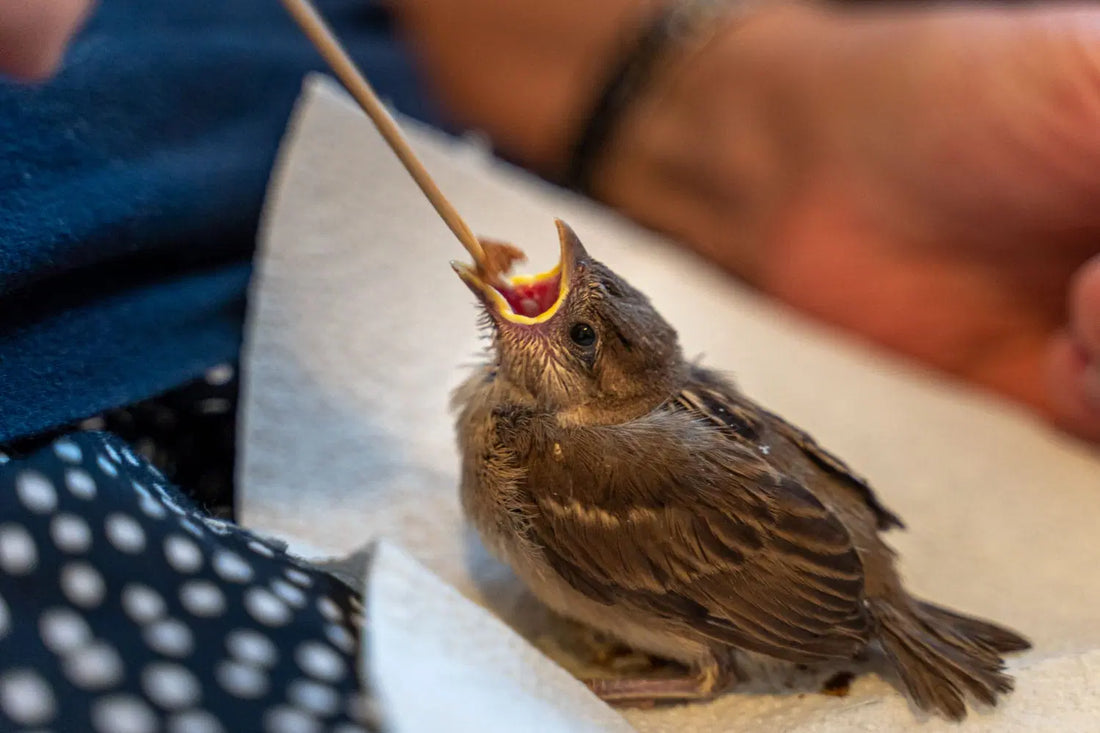
Use a small, soft-tipped syringe (1-3ml for small songbirds) or a narrow spoon to gently deliver food to the side of the bird's beak. Here's the process:
- Wait for the gape. A hungry baby bird will open its mouth wide (called "gaping") when it senses movement or vibration near the nest. Gently tap the side of the box or the base of the beak to stimulate this response.
- Deliver food to the side of the beak. Place a small amount of formula into the mouth, aiming toward the back and side. Avoid pushing food straight down the throat.
- Go slowly. Let the bird swallow between each small amount. Rushing increases the risk of aspiration or overfilling the crop.
- Stop when the bird stops gaping. A baby bird that turns away or closes its beak is telling you it's full. Don't force more food.
If the bird won't gape at all, it may be too cold, too stressed, or too sick to eat. Go back to warming and calming before trying again. A baby bird that refuses to eat for more than a few hours needs an avian veterinarian or wildlife rehabilitator.
Understanding the Crop
The crop is a pouch at the base of the bird's neck, right where the neck meets the upper chest, where food is stored before digestion. You can usually see or feel it as a visible bulge on the front of the chest after feeding. Learning to monitor the crop is essential for safe hand-feeding.
Before each feeding, check whether the crop has emptied from the previous meal. A crop that hasn't emptied (called "slow crop" or "crop stasis") can indicate illness, food that's too cold, or a formula that's too thick. According to VCA Animal Hospitals, never add new food on top of undigested food. If the crop isn't emptying within 3-4 hours, consult an avian veterinarian.
A healthy crop cycle looks like this: the crop fills visibly after feeding, then gradually empties as the food moves into the digestive system. Crop emptying time varies significantly by the bird's age, species, formula consistency, and ambient temperature, so always check the crop before each feeding rather than relying on the clock alone.
Feeding Schedule by Age
How often you feed depends on the bird's age and development stage. These are general guidelines, as different species have slightly different needs:
- Hatchlings (eyes closed, no feathers): Every 15-30 minutes from dawn to dusk, per the MSD Veterinary Manual. Yes, that's extremely demanding, which is why hatchlings really need a professional rehabilitator.
- Nestlings (eyes open, some feathers): Every 30-60 minutes during daylight. As feathers develop more fully, you can gradually extend to every 1-2 hours.
- Older nestlings approaching fledging: Every 2-3 hours, about 5-6 feedings per day. Watch the crop to time your feedings.
- Fledglings beginning to self-feed: Every 3-5 hours, supplementing as they learn to eat on their own.
Do not feed overnight. In the wild, parent songbirds don't feed at night, and baby birds are adapted to fast during darkness. The exception is very young hatchlings under a few days old, which may need one feeding around midnight, but this situation really calls for a professional rehabilitator.
At each feeding, offer food until the crop is visibly full but not overstretched. A small amount of food at each feeding is better than one large meal, as an overfilled crop can lead to aspiration or impaction.
Hygiene and Safety
Wild baby birds are extremely vulnerable to bacterial infections, and keeping things clean can be the difference between a bird that thrives and one that gets sick. In nature, parent birds keep the nest clean instinctively. When you're caring for baby birds, that responsibility falls to you.
- Wash your hands thoroughly with soap and hot water before and after each feeding and handling session. This protects both you and the bird.
- Clean feeding tools after every use. Syringes and spoons should be washed in hot, soapy water and rinsed thoroughly. Harmful bacteria multiply fast in formula residue.
- Change bedding frequently. Replace paper towels or cloth liners in the box at least once daily, or whenever soiled. Droppings and spilled food create a breeding ground for bacteria.
- Provide fresh water in a shallow dish (for fledglings only, not hatchlings or nestlings who could drown in even small amounts). Use bottled water or fresh tap water, changed daily.
- Keep the space warm and ventilated. A warm, stuffy box with no airflow encourages bacterial growth. Make sure your box has adequate air holes.
Also worth noting: wild birds can carry diseases transmissible to humans, including salmonella. This is another reason to get the bird to a licensed rehabilitator as soon as possible, and to wash your hands thoroughly after every interaction.
Weaning and Transition to Solid Food
As a baby bird grows and becomes more active, you'll need to gradually transition it from hand feeding formula to solid foods. This process, called weaning, is a critical milestone that mimics what parent birds do naturally in the wild.
You'll know the bird is approaching weaning age when it's fully feathered, starting to flutter its wings, and showing interest in objects around it (pecking at the bedding, for instance). At this stage, start introducing small amounts of age-appropriate solid foods alongside the regular formula.
For insect-eating songbirds, offer small pieces of mealworms, waxworms, or other soft insects in a shallow dish. For seed eaters, try pelleted diets designed for the species, soaked briefly to soften them, along with tiny pieces of fresh fruits and vegetables. Keep offering formula at regular intervals while the bird learns to eat independently.
The transition takes time. Don't rush it. Gradually reduce formula feedings as the bird eats more on its own, and monitor its weight to make sure it's maintaining healthy growth. Once the baby bird is eating independently and maintaining its weight, you can phase out hand feeding formula entirely. For more on what adult wild birds eat, check out our guide to feeding birds for a thriving backyard ecosystem.
If you have any concerns about the weaning process, consult an avian veterinarian for guidance tailored to your bird's species and needs.
Recognizing Signs of Trouble
Even with the best care, things can go wrong. Watch for these warning signs that require immediate professional intervention:
- Gasping, open-mouth breathing, or clicking sounds
- Listing to one side or inability to hold its head up
- Wing droop, leg injuries, or visible wounds
- Strings, fishing line, or debris wrapped around any body part
- No droppings after feeding (indicates a possible blockage)
- Prolonged lethargy or refusal to eat for multiple feedings
- A crop that won't empty after 3-4 hours
- Discolored or foul-smelling crop contents
If the baby bird shows signs of fullness or distress during feeding, stop feeding immediately to prevent overfeeding or choking. An overfull crop can lead to aspiration, which is often fatal.
For any of these situations, contact a wildlife rehabilitator or avian veterinarian right away. You can search the Animal Help Now directory to find emergency wildlife help near you.
Final Thoughts
Baby birds require specific, careful nutrition that's genuinely difficult to replicate outside of professional care. The right baby bird food, proper feeding technique, and good hygiene can keep a bird alive during the critical hours before you can get it to a rehabilitator, but temporary emergency care is exactly that: temporary.
If you've found a baby bird and you're reading this article right now, here's your action checklist:
- Identify: Is it a hatchling, nestling, or fledgling? Fledglings usually don't need help.
- Warm: Get the bird warm before doing anything else.
- Contact a rehabber: Use the NWRA directory or Animal Help Now to find professional help.
- Feed if necessary: Use commercial hand feeding formula if available, emergency food if not.
- Get the bird to a professional as soon as possible.
Caring for wild birds, even temporarily, is one of the most meaningful things you can do as a birder. With the right knowledge and a calm approach, you can genuinely make a difference during those critical first hours until baby birds can get the professional care they need.