

Hummingbird Nests: What They Look Like and Where to Find One
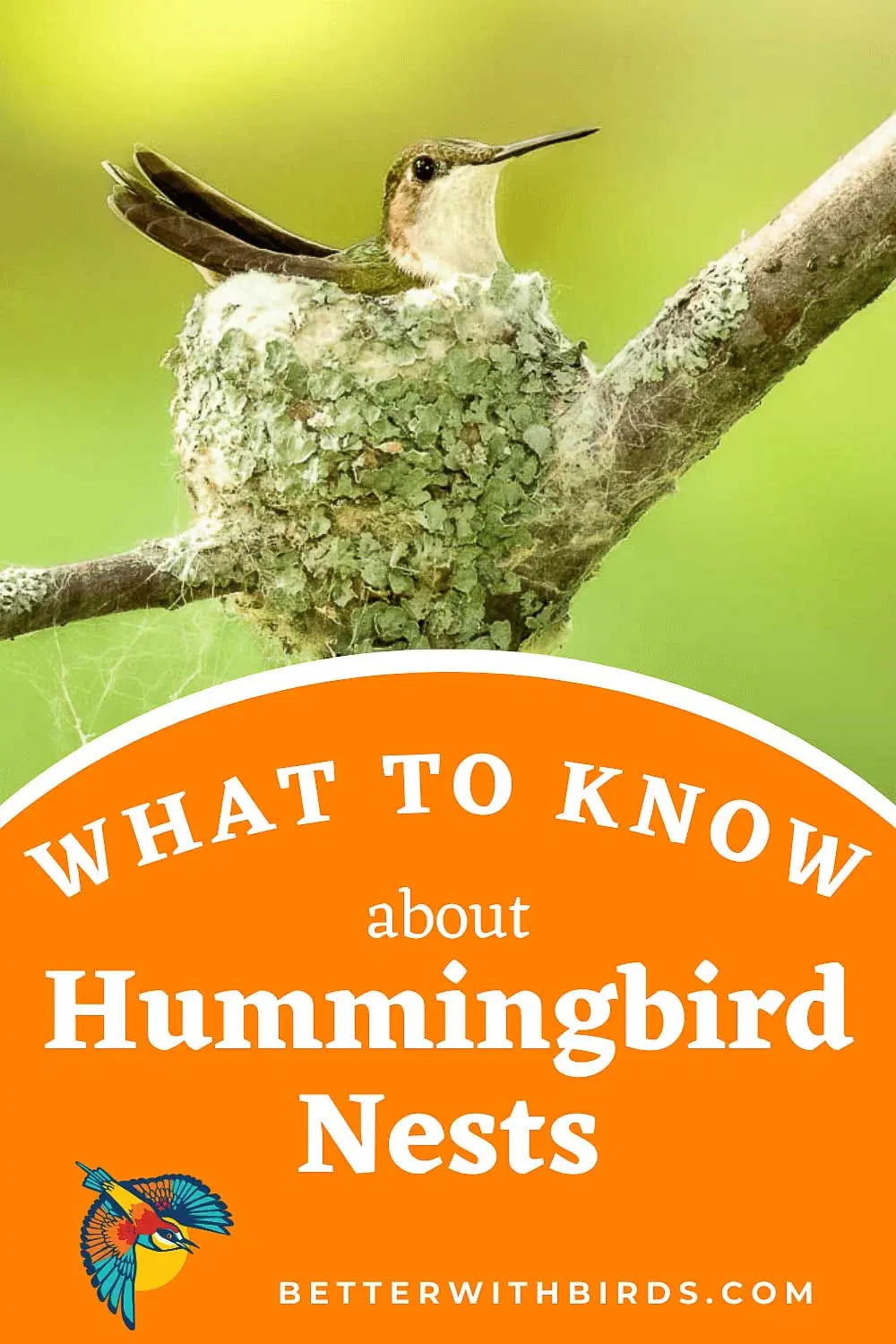
Feature photo: Ruby-throated Hummingbird female on her nest by Travis Potter/Shutterstock
Read Time: 19 minutes

This post contains affiliate links. If you use these links to buy something, I may earn a commission at no additional cost to you. I only recommend products I fully support or use myself. My full disclaimer
PIN THIS FOR LATER
Contents
A hummingbird nest is a soft cup about 1.5 to 2 inches across and an inch deep, made of plant down bound together with spider silk. Flakes of lichen (the crusty gray-green growth on bark) cover the outside and help the nest pass for part of the branch it sits on.
Inside, there are usually two white eggs, each about half an inch long.
Where to look depends on the species. Ruby-throated Hummingbirds in the East usually nest 10 to 20 feet up in leafy trees, while a few western species build at about eye level or lower, in shrubs, vines, and small trees.
How do you find one? Watch the female. If she leaves your feeder in a straight line for the same branch, over and over, give that branch a slow look through binoculars.

What a hummingbird nest looks like and how it’s built
The textbook version is a small, round cup sitting on top of a branch. Each species tweaks the design a little.
A Calliope Hummingbird often builds where an old pine cone grew, and the finished nest passes for one more cone. Black-chinned females make a deep cup whose rim curves slightly inward.
Hummingbird nest size and shape
Picture a ping-pong ball cut in half. That’s close to the size of a hummingbird nest.
Most measure 1.5 to 2 inches across (about the size of a walnut) and around an inch deep. Costa’s Hummingbirds build some of the smallest, roughly 1.25 inches across.
Inside, the cup is tiny. In a Ruby-throated Hummingbird’s nest it’s about the size of a large thimble, which leaves walls roughly a third to half an inch thick, packed with plant down, silk, and lichen.
Seen from the ground, a finished nest looks like a small knot on a tree branch. With leaves hanging over it, as they usually are, one can sit right above your head for weeks without anyone noticing.
What hummingbirds build their nests with
The base is plant down, the soft fluff from cattails, thistles, dandelions, willows, and flowers in the sunflower family.
Moss, bark, leaves, and small feathers go in too. Some Ruby-throated Hummingbirds add pine resin, and Anna’s Hummingbirds have been known to work in paint chips.
What holds all that fluff together? Spider silk.
The female gathers it straight from spider webs, letting the strands stick to her bill and breast.
Back at the nest she presses and stretches the silk over the down, moss, and lichen, and that same silk fastens the finished cup to its branch (or to whatever odd support she picked instead).
Silk is sticky, stretchy, and tough, so it does two jobs. It glues the nest into one piece, and it lets the walls give as the chicks grow.
That stretch is how a cup built around two tiny eggs ends up holding two nearly grown birds.
The outside gets a final coat of lichen and moss, pressed on with more silk.
Camouflage is the usual explanation, and probably the right one. Even from a few feet away, a finished nest is hard to pick out from its branch.
One researcher who studied lichen-covered nests from more than 50 bird species noticed something odd. Those nests usually sat on branches that had no lichen at all.
The idea is that pale flakes reflect light and break up the nest’s outline until it fades into the background.
Hummingbird nests weren’t part of that work, so for them it’s still an open question.

A female Anna’s Hummingbird gathering cattail down for her nest. Photo: Feng Yu/Shutterstock
How long does nest building take?
About a week, give or take.
Ruby-throated females need 6 to 10 days. Across the US species, building takes anywhere from 4 or 5 days for Costa’s and Broad-tailed Hummingbirds to as many as 13 for an Allen’s.
She builds one load at a time, a tuft of down here and a strand of silk there, and shapes the cup with her own body by sitting in it and pressing the rim into place.
A Ruby-throated female goes further. She smooths the rim between her neck and chest and stamps on the floor of the cup to stiffen it.
Some females cut corners. Anna’s Hummingbirds sometimes pull material out of other active nests, and Allen’s Hummingbirds often build right on top of an old nest or strip one for parts.
The female builds and raises the family alone
A female hummingbird does every job herself.
She picks the site, gathers the material, builds the nest, lays and incubates the eggs (keeps them warm until they hatch), and keeps feeding the chicks for a while after they’ve left the nest.
Among birds, that’s unusual. Most species split the work between two parents, and hummingbirds sit in the much smaller group where the female does all of it alone.
The male’s part ends at mating
Where’s the male during all this? Not at the nest.
Ruby-throated Hummingbird pairs stay together just long enough for courtship and mating, a few days to a few weeks, which keeps hummingbirds well off any list of birds that mate for life.
His big contribution is the courtship show. A male Ruby-throated swings through wide U-shaped dives that start as high as 50 feet. A male Anna’s climbs to about 130 feet, then plunges.
After mating he moves on, and he spends the rest of the season defending his territory.
What happens in a hummingbird nest, from eggs to fledging
From the first egg to the first flight takes about a month for a Ruby-throated Hummingbird, and five to seven weeks for some western species.
Hummingbird eggs
A hummingbird nest usually holds two eggs, each about the size of a jellybean. The female lays one, and the second follows one to three days later.
Ruby-throated Hummingbirds occasionally lay one or three. Rufous Hummingbirds sometimes lay three.
They’re plain white and only about half an inch long, a touch smaller for a Calliope Hummingbird.
A Ruby-throated egg weighs about half a gram. Hummingbird eggs are among the smallest bird eggs in North America.
How long the eggs take to hatch
A Ruby-throated Hummingbird incubates her eggs for 12 to 14 days. Many western species take longer, up to about three weeks for an Allen’s Hummingbird.
Because she starts sitting as soon as the first egg is laid, the chicks hatch one to three days apart, in the order the eggs arrived.
Does she ever leave? Only briefly. A Ruby-throated female spends about three-quarters of the daylight hours on her eggs, plus the whole night, and her breaks are short trips for nectar and insects.
Many nests come with a roof.
Ruby-throated nests are usually wrapped in leaves, while Calliope and Broad-tailed Hummingbirds tuck theirs under overhanging branches that keep off rain and cold and hold in warmth at night.

Two white eggs in a lichen-covered Ruby-throated Hummingbird nest. Photo: Travis Potter/Shutterstock
What newly hatched chicks look like
Nothing like hummingbirds yet. A newly hatched chick is naked apart from two thin lines of gray down along its back, with dark skin and eyes sealed shut.
Then they grow, fast. A Ruby-throated chick doubles its weight by day three, doubles it again by day five, and again by about day eight.
For roughly the first nine days the female broods them, sitting on the nest to keep them warm. Once their eyes open, around day nine, she starts bringing whole insects.
How the female feeds her chicks
The first time you watch a feeding, it looks alarming. The female pushes her long bill deep into a chick’s throat and regurgitates a mix of nectar and tiny insects straight into it.
She makes many trips a day, every day, until the chicks fly.
Between visits she’s catching small insects, picking spiders and trapped bugs out of webs, and drinking nectar from flowers and feeders.
Nectar is low in protein. Chicks get the protein they need to grow from those insects and spiders, which is why a yard full of small bugs pays off during nesting season.
How long baby hummingbirds stay in the nest
Ruby-throated chicks stay in the nest for 18 to 22 days, going from naked and blind to fully feathered and ready to fly.
Across species, the stay runs from about 15 days for a Rufous Hummingbird to as many as 30 for a Costa’s.
Two nearly grown chicks in one tiny cup? By the end, the nest looks far too small.
Its walls have stretched outward, and some nests change shape completely. A Black-chinned Hummingbird’s deep cup turns wide and shallow, and a Broad-tailed’s flattens into something closer to a platform.
The chicks often leave heavier than their mother and slim down while they learn to feed themselves.
A Ruby-throated female keeps feeding her fledglings (young birds that have just left the nest) for about a week after they fly, sometimes a little longer, while they work out flowers, feeders, and insects on their own.
And her season may not be over. Anna’s and Allen’s Hummingbirds regularly raise two broods (sets of chicks) a year, sometimes three, and the second brood usually gets a new nest.
 A female hummingbird feeding her two chicks in the nest. Photo: sen yang/Shutterstock
Where hummingbirds nest and how to find one
Hummingbirds nest in trees, shrubs, and vines, anywhere from a few feet off the ground to about 50 feet up, usually on a slender branch with leaves or another branch overhead.
Usual nest sites and heights
In the East, a Ruby-throated Hummingbird usually builds 10 to 20 feet up (occasionally as high as 50) in a deciduous tree such as an oak, birch, poplar, or hackberry, picking a thin branch that often slants downward and setting the nest right on top.
Leaves usually hang above and around it.
Farther west? Many nests sit lower. Anna’s Hummingbirds usually build 6 to 20 feet up, Costa’s Hummingbirds just 3 to 7 feet off the ground in desert shrubs, and Black-chinned nests average about 6 feet.
Food is the other clue. Anna’s Hummingbirds choose nest sites near a source of nectar. Ruby-throated Hummingbirds sometimes nest near sapsucker wells, the small holes these woodpeckers drill so sap will flow.
Nests on wind chimes, wires, and planter hooks
Every so often a hummingbird builds on something people made, and it happens more often in the West.
Nests have turned up on loops of chain, wire, and extension cord. Others have sat on wind chimes, outdoor faucets, and string lights, or under the eaves of houses.
What these odd spots share is what a good branch offers (something firm underneath and a bit of cover), and a patio planter hook has both.

A female Anna’s Hummingbird adding plant down to her half-built nest on a vine. Photo: Pamela Astrogypsies/Shutterstock
How to spot a hummingbird nest
Start with the bird. A female gives her nest away through her behavior long before you could pick the cup out of the leaves.
See a female flying to the same spot again and again with a tuft of plant down or a wisp of spider silk in her bill? She’s building.
If she flies into one spot and stays put for a long time, she’s probably sitting on eggs.
During nesting season, your feeder is a good place to watch from. Note where a female goes when she’s done drinking. A fast, straight line to the same tree, repeated through the day, points toward the nest.
Once you find a nest, keep your distance.
Crowding a female early in incubation can make her abandon it. Visit when the chicks are nearly ready to fly, and you can push them out early, which lowers their odds.
If you do go closer, follow standard nest-monitoring rules. Skip early mornings, dusk, and bad weather, keep any visit under a minute, and leave by a different path so you don’t lay a scent trail to the nest.
A window or binoculars give you the whole show with none of that risk.
To keep the weeks from eggs to fledging straight, try this guide to what to write, sketch, and track in a bird journal.
I remember finding a hummingbird nest one fall, tucked in the Y of a blackberry vine. Nesting season was well past, and the nest was long abandoned.
It felt like stumbling onto an archeological find, a bit of pottery from 1,000 years ago. Up close, I could finally see the materials she’d used and how intricately she’d put them together. Miraculous!
An old nest like that is still protected.
Under the Migratory Bird Treaty Act, the federal law covering migratory birds and their nests, you need a permit to keep one, even if it’s empty or has fallen to the ground.
Clearing away an inactive nest is fine as long as you don’t keep it. Destroying an active nest, with eggs or chicks in it, is illegal.

A female hummingbird sitting on the nest she built inside a patio planter hook.
Photo: Florence-Joseph McGinn/Shutterstock

A hummingbird settled on its tiny nest on an avocado branch, with two avocados alongside for scale. Photo: Ali Peterson/Shutterstock
How hummingbird nests differ by species
There are about 363 hummingbird species, every one of them in the Americas, and only about 15 appear on the US list.
The table compares seven that nest here. Its numbers are typical ranges from species accounts, so a real nest can fall a little outside them.
| Species | Nest width (outside) | Usual nest height | Incubation (days) | Days in the nest |
|---|---|---|---|---|
| Ruby-throated | About 2 in | 10 to 20 ft, up to 50 | 12 to 14 | 18 to 22 |
| Anna’s | About 1.5 in | 6 to 20 ft | 14 to 19 | 18 to 23 |
| Black-chinned | Deep cup | About 6 ft on average | 12 to 16 | About 21 |
| Rufous | About 2 in | Up to about 30 ft | 15 to 17 | 15 to 19 |
| Allen’s | Inner cup about 1.25 in | 2 to 50 ft | 17 to 22 | 22 to 25 |
| Costa’s | About 1.25 in | 3 to 7 ft | 15 to 18 | 20 to 30 |
| Calliope | 1.5 to 1.8 in | 6 to 39 ft | 15 to 16 | 18 to 21 |
Ruby-throated Hummingbird nests
The Ruby-throated Hummingbird is the only hummingbird that nests in eastern North America, and it has the largest breeding range of any North American hummingbird.
Found a hummingbird nest anywhere in the East? It belongs to a Ruby-throated.
A female raises one or two broods a year, occasionally three.
She may start her second nest while she’s still feeding the first brood, and in the South she sometimes reuses the first nest instead of building another.
Ruby-throated Hummingbirds are long-distance migrants. In fall some fly straight across the Gulf of Mexico, while many others follow the Texas coast around it.
That squeezes every nest in between the spring arrival and the fall trip, a tighter window than a year-round Anna’s Hummingbird gets.
Anna’s Hummingbird nests
Anna’s Hummingbirds are among the most common hummingbirds along the Pacific Coast, and most of them stay all year.
Staying put lets them start early. A female may begin nesting in December or even sooner, long before spring.
Most nest on branches of oaks, sycamores, and eucalyptus, or in vines and shrubs. Even poison oak. Some use wires or the eaves of a house.
Live on the West Coast? Keep looking through the winter. If your feeders stay up year-round, an Anna’s female could be sitting on eggs while you’re still in a winter coat.

Most Anna’s Hummingbirds stay on the West Coast all year. Stitch one hovering in a floral wreath with the Anna’s Hummingbird cross-stitch pattern.
Other western species
Every other hummingbird that nests in the US does it in the West or Southwest. These six each favor their own kind of spot.
- Rufous Hummingbirds nest farther north than any other hummingbird, all the way to southeast Alaska. The female hides her nest in the drooping branches of a spruce, cedar, Douglas-fir, hemlock, birch, or maple.
- Allen’s Hummingbirds are back on the Oregon and California coast as early as January, nesting near shady streams and in blackberry tangles, bracken fern, eucalyptus, and cypress.
- Black-chinned Hummingbirds are common in canyons and along rivers in the Southwest. A female likes a small, bare, horizontal branch below the canopy, and where it’s cooler she builds thicker walls.
- Costa’s Hummingbirds nest in desert scrub (palo verde, ironwood, cholla, or acacia), often in a fairly open spot. Their cups run flimsy.
- Calliope Hummingbirds, the smallest breeding birds in the US, nest on conifer branches.
- Broad-tailed Hummingbirds breed high in the Rockies and other western mountains, roughly 5,000 to 10,500 feet above sea level. They nest on evergreen or aspen branches, or in willow and alder thickets.
Rufous Hummingbirds are fiercely territorial, nest included. Females have been seen chasing chipmunks away, and yet 20 or more nests sometimes sit just a few yards apart.

Stitch your favorite feisty hummer
This Rufous Hummingbird cross-stitch pattern captures that fiery personality in a vintage botanical style.
How to help hummingbirds nest in your yard
A nesting female needs three things close together: nectar, small insects and spiders, and soft material to build with. Give her all three in a pesticide-free yard and her job gets a lot easier.
Plant a hummingbird-friendly garden
Only have time for one thing? Plant flowers. A garden that blooms from early spring through late summer keeps nectar close to the nest all season.
Red or orange tubular flowers are the usual favorites. Ruby-throated Hummingbirds in the East go for trumpet vine and cardinal flower, and western species work columbine, penstemon, paintbrush, sage, currant, and manzanita.

Love that trumpet vine? The Folk Hummingbirds stick and stitch pattern sets hummingbirds hovering among it and other trailing flowers.
Leave room for nest fluff, too. A willow, a patch of milkweed, or a few thistles and dandelions left to go to seed all make the soft down females collect.
Trees and shrubs give her somewhere to build, and even a small ornamental tree can help.
Anna’s Hummingbirds expanded their range in the 1900s partly because people planted flowering trees from other parts of the world, which handed them nectar and nest sites at once.
For timing, see this guide to prepping your garden for birds in spring.
For what to plant, start with how to plant a hummingbird garden.
Keep feeders clean and stocked
A feeder fills the gaps when flowers aren’t blooming, and a female nesting nearby can lean on it all season.
How often should you clean it? It depends on the weather.
Empty and clean it every day or every other day when it’s hot, every three days in mild weather, and twice a week when it’s cool.
Clean it any time it runs empty, turns moldy, or a sick bird has used it. Hot water with a little hydrogen peroxide or a weak vinegar solution works. Skip the dish soap.
For the nectar, stir about a quarter cup of sugar into each cup of water and leave out the food coloring.
This guide to making hummingbird nectar at home has the full method.
Skip the pesticides
Pesticides kill the small insects and spiders that nesting females eat and feed to their chicks.
Spraying away spiders hurts twice, because they’re protein for the chicks and their silk is what holds hummingbird nests together.
Leave nesting material and skip the hummingbird house
Go easy on yard cleanup. Leave some leaf litter, let moss grow on the branches, and don’t knock down spider webs in sheltered corners, since females collect that silk.
Putting out nesting material? Stick to natural, untreated plant fluff and down.
Yarn, string, and twine can tangle adults and chicks. Dryer lint can carry chemicals and falls apart when wet. Pet hair can hold flea treatments and shampoo, and human hair can wrap around a bird’s legs, so leave both out.
What about those tiny hummingbird houses? They don’t work.
Hummingbirds don’t nest in boxes or cavities. A female builds out in the open on something that holds the nest up from below, with a little cover overhead, which makes a house decoration at best.
You can’t build the nest for her, but you can offer a spot.
Hummingbirds occasionally nest on porches and patios, mostly in the western US, so a simple branch-like support under the roof, made from scraps you already have, might get noticed, though it’s a long shot.
For more ways to bring hummingbirds in during nesting season, see this guide to attracting hummingbirds to your yard.
Frequently asked questions about hummingbird nests
When do hummingbirds nest?
From as early as December on the Pacific Coast to as late as August in the North, depending on the species and how far north you live.
- Anna’s Hummingbirds on the Pacific Coast can start in December, or even earlier.
- Ruby-throated Hummingbird eggs show up from about mid-April in the South to mid-August in the North, peaking in late May and June.
How rare is it to see a hummingbird nest?
Less rare than it feels.
Wherever hummingbirds breed, there are nests. Each one is barely 2 inches across, coated in lichen, and usually tucked under leaves, which is why they’re so easy to miss. To find one, watch where a female flies after she feeds.
Do hummingbirds reuse their nests?
Usually not. A hummingbird nest isn’t durable enough for repeated use, so most females build a new one for each brood.
A few species bend the rule. Calliope and Allen’s Hummingbirds sometimes build a fresh nest right on top of an old one, Costa’s occasionally do the same, and Broad-tailed Hummingbirds sometimes reuse a nest from a previous season.
What eats hummingbird eggs and chicks?
Snakes, chipmunks, and squirrels take them, though not often. Jays occasionally take hummingbirds too.
Losses at the nest are probably uncommon, because a successful nest usually sits out on a branch tip too thin for a predator to reach.
Adults face a different list, including house cats at feeders. Free-roaming cats kill an estimated 1.3 to 4 billion birds a year in the US, so keeping yours indoors removes one of the biggest threats backyard birds face.
What should you do if you find a baby hummingbird on the ground?
If you can find the nest, put the chick back in it. If you can’t, leave it somewhere shaded and call a licensed wildlife rehabilitator.
Don’t try to raise or feed it yourself.
Hummingbird chicks need care from a federally permitted rehabber. As this guide to what baby birds eat points out, a baby hummingbird needs a completely different diet than a baby robin or crow.
Report a nest to NestWatch
Found an active nest? You can add it to NestWatch, a citizen-science project that collects records of bird nests.
The project asks for a check every three or four days, though a weekly one still helps, and each visit should stay under a minute.
For the note-taking side, this guide on how to start a bird journal covers what to record and why it matters.

Track your nest observations
The Songbird Damask Hardcover Journal has room to log nest visits, sketch what you see, and record dates from egg to fledging.
Hoping for photos of the comings and goings? Work from a window, or from well back with a long lens. This guide to photographing hummingbirds is a good next stop.
🌺 Want to attract more hummingbirds nearby?
A reliable feeder near a nesting tree keeps nectar close for a busy female. Start with my two favorite hummingbird feeders, or see the best bird feeder cameras of 2026 guide if you want to catch hummingbird visits on video (their tiny size makes them tricky on most cameras).
From the BWB shop, for hummingbird fans
For hummingbird lovers, the Hummingbirds collection has six pieces right now: cross-stitch patterns of Anna’s and Rufous Hummingbirds, the Folk Hummingbirds stick and stitch pattern, and the heavy metal Trochilidae design on a tee, a women’s tee, and a hoodie.


Browse the Hummingbirds collection
Shopping for a hummingbird lover? The Trochilidae tees and hoodie and the Anna’s and Folk Hummingbirds patterns are also in the gifts for bird lovers collection.
Free tool from Better With Birds: Try the Plants for Birds planner to get a ZIP-specific native plant list filtered to the birds you actually want. No email, no ads.