

How to Bird by Ear: A Step-by-Step Guide to Getting Started
This post contains affiliate links. If you use these links to buy something, I may earn a commission at no additional cost to you. I only recommend products I fully support or use myself. My full terms
PIN THIS FOR LATER
Contents
Birding by ear means matching birds to their sounds. You hear a song or a call, and you put a name to the bird that made it.
Lounging in the garden or hiking a rugged trail, you’ll get more out of birdwatching once you can do it.
(Plus, if you’re like me and one ear doesn’t work so well, you’ll get really good at turning your head to triangulate where the heck the song is coming from.)

The art of listening to bird songs
Putting names to birds is only part of it. The rest is tuning in to the whole wash of sound around you and noticing how much is going on out there.
Your ears also find birds your eyes can’t. Some birds stay hidden from view, and their songs alone are enough to identify them.
So where do you begin? With what’s called an auditory survey.
It’s a first listening pass that tells you which species are present from the moment you step into an area.
Birding by ear also opens the hobby up to people who are visually impaired, which shows how wonderfully inclusive birdwatching can be.

First thing in the morning is a magical time to bird by ear. Pinpointing songs then can feel a bit overwhelming, but that chaotic energy is part of the thrill. (Tree swallow.)
The dawn chorus
You’ve probably heard the dawn chorus, even if you never stopped to take it all in.
It’s the stretch just before and during the early hours of sunrise when a wide variety of birds sing.
For birding by ear, that time is golden. There’s a flurry of activity, and birds tend to be more vocal at the start of the day.
How do you untangle all of it? Pick one bird.
Zero in on that single singer and you can pick its song out of the chorus. Settle in, let the morning surround you, and listen closely to what each bird adds to it.
Recognizing patterns and rhythms
Many birds have a signature rhythm, pitch, or tone that makes them stand out, and learning to hear those patterns is a key skill in birding by ear.
The Chipping Sparrow is a good example. Its steady trill works like a personal calling card.
Then there’s the Northern Mockingbird, famous for repetitive song patterns. It often repeats phrases, building a sequence you’ll learn to recognize.
The more you tune in, the more these musical signatures separate out by species, and the more you notice the details that make each bird’s song its own.
The science behind bird calls and songs
Part of what makes bird songs so captivating is the job they do. Songs play a big role in:
- Mate attraction, with a superior quality song suggesting the bird’s good fitness
- Courting mates and warding off competitors during breeding seasons
- Territorial negotiation, which stands in for physical confrontations and so prevents costly and unnecessary conflicts.
And that’s only the songs. The other vocalizations are coming up shortly.
Mimicry is nature’s karaoke, and it carries information too. Birds pick it up through imitation, and the precision and accuracy of the copying can tell us about a bird’s genetic health and how well it has developed.
One more. Want a clue about a bird’s size? Listen to the pitch.
Smaller birds usually chirp at a higher pitch. Larger birds tend to have deeper, more resonant calls.

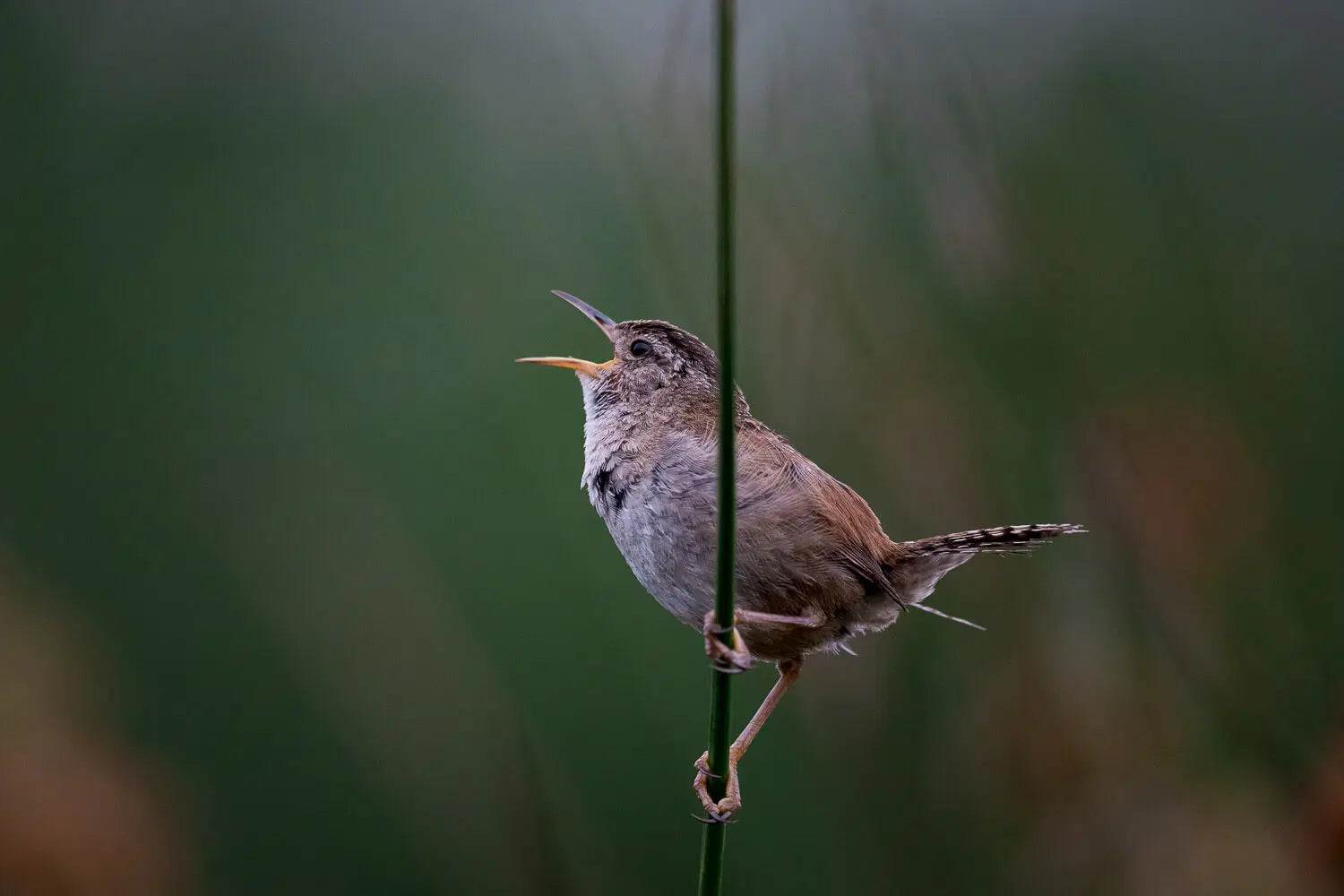
Males often get the credit for songs like this wren’s. But the sounds of the bird world are WAY more complicated than that!
Male vs. female vocalizations
Males usually take center stage, serenading potential mates or belting out warnings to rivals.
Birds are full of surprises, though. In many species, females have their own repertoire of songs, and those can be just as complex and just as vital to survival.
The Female Bird Song Project is an initiative to deepen our understanding of these female singers.
It asks birdwatchers like you to take part by gathering observations and making recordings. That way we can all help shine a spotlight on singers that often get overlooked.
Out with your binoculars next time? Try to pick out the distinct tunes of the males and the females. It’s a rewarding challenge, and it adds another layer to birding.
What different bird sounds mean
For birds, vocalizations are key to survival and social life. Each type has its own purpose:
- Songs: Mostly sung by males, these complex melodies are about attracting mates and staking out territory. They’re like the bird version of a serenade mixed with a warning.
- Calls: These are the quick messages of the bird world, used for everything from signaling danger to coordinating with the group. They’re short, to the point, and can vary from sharp alerts to gentle coos.
- Contact Calls: These help birds keep in touch with each other, especially when they’re not in visual range. Think of them as the “hey, where are you?” of bird sounds.
- Begging Calls: Used by chicks, these are loud and demanding, designed to ensure they get fed. It’s all about getting the parents’ attention in a noisy nest.
- Alarm Calls: Sharp and urgent, these calls spread the word quickly when there’s a predator nearby, helping the flock to react swiftly.
- Flight Calls: Birds use these during flight to stay connected with their flock mates, especially useful during night migrations or in poor visibility.
- Territorial Calls: These vocalizations are the bird’s way of saying “this is my space” to keep rivals at bay during breeding season.
- Mimicry: Some birds mimic the sounds of other species. This tricky behavior can help them avoid predators or sneak into new territories.

There’s more to birding by ear than listening for songs! Begging calls (like those coming from this fledgling barn swallow), flight calls, alarm calls, and more will tell you what’s shaking in the bird world.
Get familiar with common birds first
New or seasoned, any birder gets more out of it after learning the common birds and their voices.
Eight good ones to start with:
- American Robin: Listen for a cheerful, melodious song that consists of a series of clear whistles, often described as “cheerily, cheer up, cheer up, cheerily, cheer up.”
- Northern Cardinal: Recognizable by its loud, clear whistles which can vary in tempo. The song often sounds like “whoit, whoit, whoit, whooee.”
- Blue Jay: Known for a variety of sounds. Their most common call is a loud and harsh “jay, jay.” They can also mimic the calls of other species, including hawks.
- Song Sparrow: Their song is a rich, melodious mixture of notes that typically starts with several clear whistles and transitions into a buzzy and tumbling sequence.
- Mourning Dove: Easily identifiable by their soft, woeful cooing, which sounds like a mournful “coo-oo, coo, coo, coo.”
- Common Raven: Listen for a deep, resonant “croak.” Ravens can also produce a variety of other sounds, including mimicking other birds, animals, and even human-made sounds.
- Black-capped Chickadee: Recognized by their clear, two-note song that sounds like “fee-bee” with the first note higher than the second, and by their warning call of “chicka-dee-dee-dee” in which the number of “dee”s gives a hint to the seriousness of the danger. More dees, more danger.
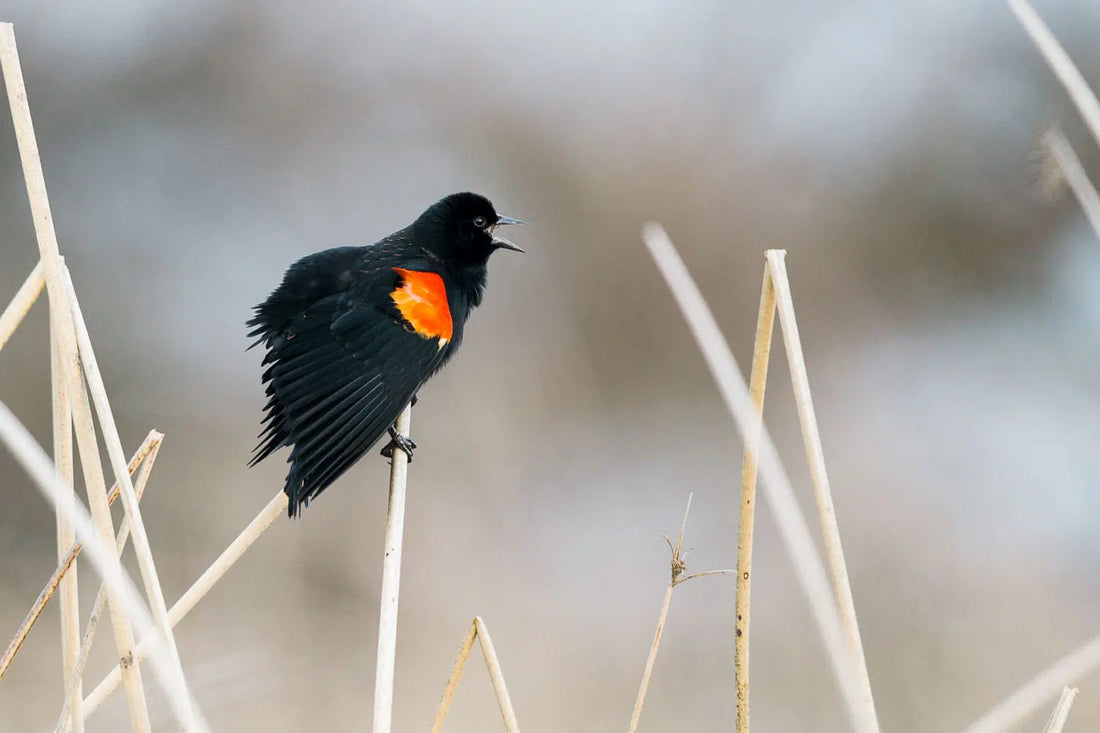
- Red-winged Blackbird: Known for their distinctive “conk-la-ree!” call, which is loud and clear with a trilling sound on the last note.
Whistles, trills, and rhythmic patterns are what help you tell these songs apart and remember them for identification. If you'd like to stitch a favorite, my vintage-style Blue Jay and Mourning Dove cross-stitch patterns are in the shop.

Some species make melodic sounds, and some make sounds that are more… well… practical-sounding, like this Virginia rail.
Describing bird sounds
Describing bird sounds can feel like learning a whole new language. Don’t worry. Mostly it comes down to tuning in and listening closely.
To start, think of calls and songs as collections of notes, much like music. Five qualities do most of the describing:
- Pitch: Is the sound high like the thin whistle of a Cedar Waxwing, or low like the deep hoot of a Great Horned Owl?
- Tempo: Consider the speed of the sound. Is it a rapid staccato like a woodpecker drumming on a tree, or a slow, soothing coo like a Mourning Dove?
- Rhythm: Listen for the pattern in the sound. Is it a repetitive series of notes like the famous “who-cooks-for-you” of the Barred Owl, or is it more erratic and varied?
- Quality: This describes the texture of the sound. Is it harsh, raspy, clear, or perhaps melodious?
- Volume: Notice the loudness of the call. Is it a booming call that echoes through the forest or a soft murmur barely audible over the rustling leaves?
Once you get the hang of these descriptors, you’ll identify birds more accurately. You’ll also hear more of the complexity and beauty in their vocal performances.
With a little practice, you’ll start to recognize distinctive sounds and what they mean in a bird’s daily life, and that makes every outing more engaging.

Once you’ve gotten familiar with the songs of birds that live near you, it becomes even more exciting to travel and hear the sounds of species that are new to you! (Lilac-breasted roller.)
Advanced techniques in birding by ear
Once you know some songs, the next step is building advanced listening skills for complex soundscapes.
Two kinds of places make good practice. Serene soundscapes are areas that seem quiet or monotone overall. Bustling ones are places like busy city parks. Either can help you detect subtle bird sounds.
The more you practice, the better you get at picking out a single bird song from a chorus of other sounds.
Techy tips for complex soundscapes
Audio software can be a huge help. Audacity, for example, has noise reduction features that sharpen the clarity of bird songs by dialing down the background racket.
High-pass filters and custom filters go further, weeding out specific noises like gusty winds or low-frequency rumbles.
That means you can take a recording you made in the field home with you, reduce the background noise, and notice nuances in the songs and calls.
Recordings are gold, in fact. Bird experts can play a sound back as many times as they need for a spot-on identification, and recordings give ongoing research a deep pool of data to work from.
Birding ethics tip: go easy on playback
A friendly heads-up for all my fellow bird enthusiasts: using playback to attract birds can be tempting. It’s worth thinking through the ethics first.
Why? Replaying calls or songs in the field can disrupt natural behavior. A bird may divert energy from vital activities like feeding, mating, or tending the nest to answer what it thinks is another bird, and that can mean unnecessary stress.
Frequent playback at popular birding spots can also lead to habituation. Birds get used to human-generated sounds and change their natural responses, something we definitely want to avoid.
Plus, natural behavior is always more interesting to watch. You never know what cool, surprising thing will happen!
So aim to watch birds with minimal impact on their natural behavior, and keep birding as respectful and sustainable as possible. Let’s keep our impact low and our appreciation high!

Birding by ear is an excellent way to locate birds that would otherwise be tough to see in the understory, like this North Island robin (Toutouwai).
Memory tricks for bird song identification
Remembering bird songs can be a challenge. Is there a trick? There are several, and tying a song to a vivid, unusual mental picture makes it a lot easier to memorize and recall each species later.
A few ways to put that to work:
- Create a personal mental narrative or scene that connects the characteristics of a bird’s song with visual elements based on the bird’s name or appearance.
- Use visual cues to associate the sound of the bird song with something memorable or unique.
- Practice listening to bird songs regularly and try to identify the species based on their unique sounds.
- Take notes or record the bird songs you hear and listen to them repeatedly to reinforce your memory.
- By using these memory tricks, you can improve your ability to remember and identify bird songs.
Test yourself regularly, too, without checking the species first. Self-testing like that leans harder on the visual memory techniques, and the songs stick better for it.

Some birds sound far bigger than their size seems capable of! The Pacific wren is one, with an extraordinarily long and complex song.
Mnemonics for bird calls
Mnemonic devices (memory aids that link a call to a familiar phrase or rhythm) are incredibly useful in birding by ear.
The American Goldfinch’s song? “Potato chip, potato chip.” And the Eastern Wood-Pewee’s call might remind you of someone saying “pee-a-wee.”
The more you practice with mnemonics, the easier it gets to recognize different calls in the wild.
A few well-known ones:
- American Goldfinch: “Potato chip, potato chip”
- Eastern Wood-Pewee: “Pee-a-wee”
- Barred Owl: “Who cooks for you, who cooks for you all”
- Common Yellowthroat: “Witchity-witchity-witchity”
- Northern Cardinal: “Cheer, cheer, cheer; what, what, what, what”
- Killdeer: “Kill-deer, kill-deer”
- Black-capped Chickadee: “Chick-a-dee-dee-dee” (and their 2-3 note “fee-bee-bee” call is often remembered by “Cheeseburger”)
- Great Horned Owl: “Who’s awake? Me too”
By the way, if you love a good dose of bird humor and an easy way to remember your favorite mnemonics, I have the perfect mugs for you in the shop!
Engaging with bird conservation through auditory monitoring
All that listening does real work for bird conservation, too. Acoustic monitoring is a low-cost, non-intrusive, automated way to study and track birds, and it plays a crucial role in protecting bird populations.
Acoustic surveys record songs and calls as evidence that a species is present in its habitat. An elusive bird that stays out of sight? That’s where recording earns its keep.
Picture automated recorders set up across several patches of forest, running around the clock and capturing the songs and calls of the wild.
Researchers use them to keep tabs on bird vocalizations. They also reveal trends in bird movements and habitat preferences.
So birding by ear does more than fill our days with birdsong. It helps us protect those songs for future generations to enjoy.
Audio equipment for birders
Good audio gear helps you catch the subtle whispers and whistles of the bird world with real clarity.
Just getting started with bird listening? Begin with a good pair of headphones and a portable digital recorder to catch those fleeting songs.
Seasoned listeners who want to zero in on faint, elusive chirps can step up to:
- Parabolic Microphones: These are fantastic for pinpointing distant bird calls, acting almost like an acoustic telescope.
- High-Quality Recorders with XLR Inputs: For the audio aficionados, these allow for connection with external mics, giving you crystal-clear recording quality.
- Noise-Canceling Headphones: Perfect for immersing yourself in nature’s soundtrack without the distraction of background noise.

Vocalizations are used for a wide variety of reasons in the avian world. And once you learn to decode them, you can figure out what’s happening around a bird even if you can’t see it. (Red-necked grebe pair warning others away from their nesting turf.)
Why point count surveys matter
Point count surveys are a vital tool for understanding which birds live in a particular area, and they play a key role in bird conservation.
New to the idea? Picture a biologist, binoculars in hand, standing in a designated spot and recording every bird seen or heard within a specific timeframe and radius.
That gives a snapshot of bird diversity and abundance, which matters for several reasons.
First, the surveys show how well our habitat management strategies are working. Are birds thriving with the changes we’ve made, or do we need to adjust?
Second, they work like an early warning system. They spot declines in bird populations before they reach critical levels, while there’s still time to step in with conservation measures.
Done regularly, these counts make sure habitats keep supporting birds so the birds can flourish for years to come. It takes science, dedication, and a deep love of birds, and it protects both the birds and the health of our ecosystems.
Citizen science opportunities
Anyone can put birding by ear to work. Through citizen science projects like Project FeederWatch and Journey North, you can contribute to bird conservation without being an expert.
These projects invite people to track bird migrations and report observations, which gives researchers valuable data.
Citizen scientists play a vital role here, helping researchers expand what we know and preserve bird species. Happy birding!

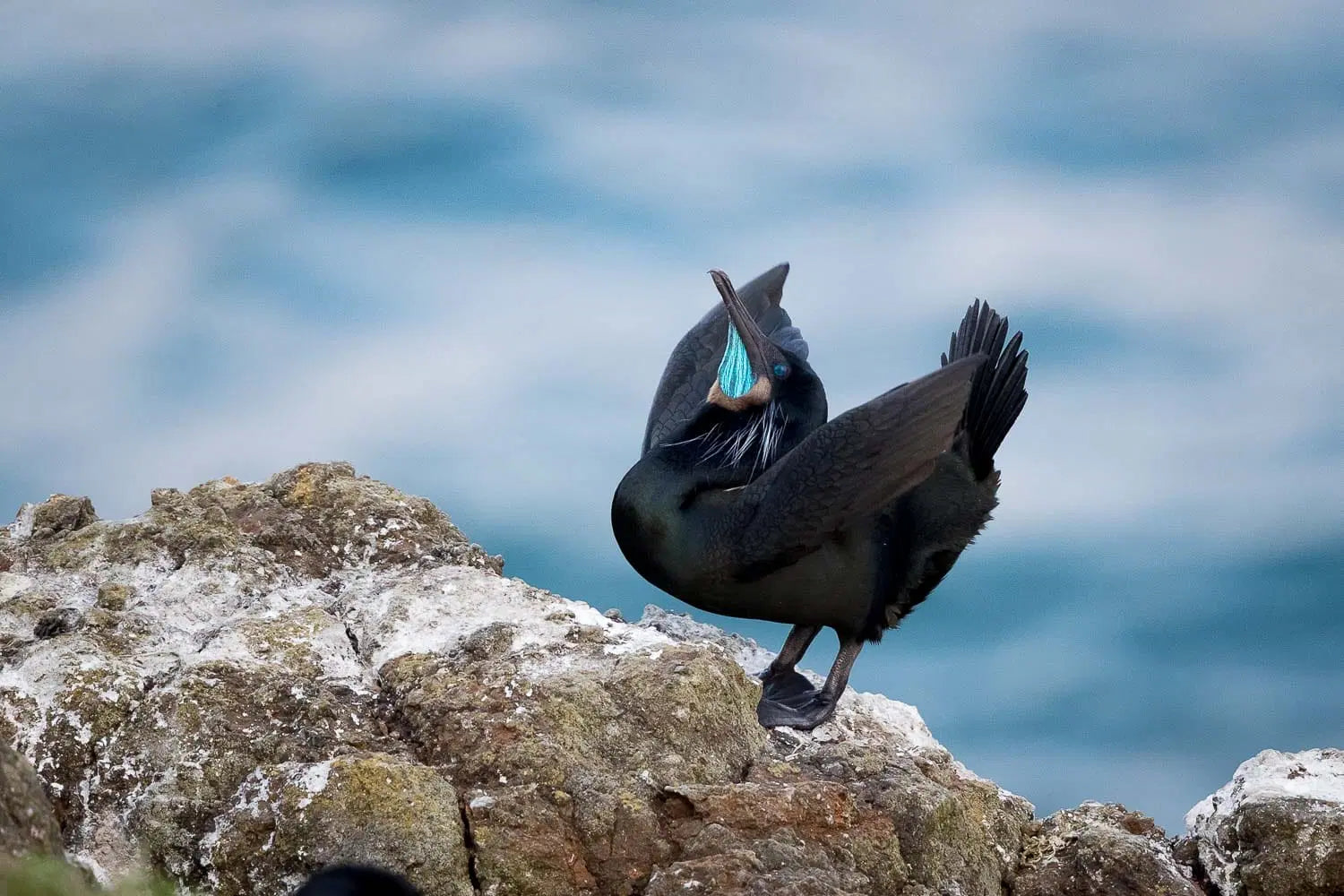
There are sounds to attract, and most definitely sounds to warn away enemies in the bird world! This Brandt’s cormorant is giving a Western Gull what-for.
Resources for boosting your birding by ear skills
- Merlin Bird ID, best known for its Sound ID feature, which identifies bird songs and calls in real time and turns your smartphone into a personal birding assistant.
- Larkwire, an app designed specifically as a learning tool for mastering bird sounds. It takes a game-based approach that makes identifying bird songs fun and effective, sorting songs into groups and following up with a series of quizzes that reinforce what you’ve learned through interactive practice.
- Bird Academy by the Cornell Lab of Ornithology offers in-depth courses like ‘Bird Song Basics: Getting Started with Birding by Ear.’ That course is ideal for beginners and gives you a solid foundation in recognizing bird songs within their natural soundscapes. It also supports a range of learning needs, including people using assistive technologies. When you finish the course, you get access to resources like the Bird Song Spotlight tool and the Cornell Guide to Bird Sounds Essential Set, which contains common songs and calls from 729 North American bird species, including those found in Central New York.
- Audubon Bird Guide app is a great tool for any birder. It has profiles for 821 North American bird species, complete with extensive sound libraries, photographs, and range maps. Beyond sound ID, all those photos and maps make it useful for the rest of your birding too.
Together, these cover beginners and experienced birders looking to refine their skills. Prefer interactive apps? Structured courses? There’s a tool here that can help you become an expert at identifying bird songs and calls.
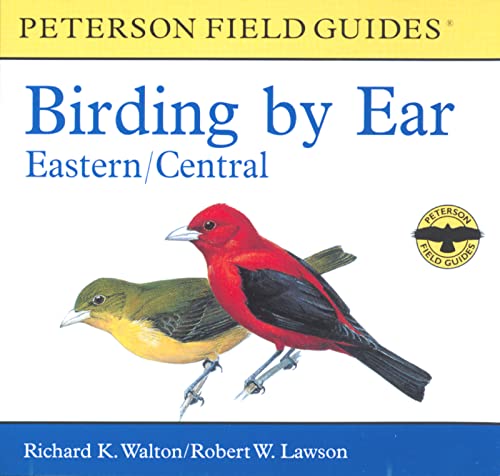
Hearing calls over and over helps a lot.
It’s a pretty old-school method, but popping these CDs in and playing them on repeat during drives was amazingly helpful to me. (Plus it was fun to freak someone out for a second when they hopped in to ride shotgun.)


More of a visual learner? These field guides are exceptional. They show spectrograms (visual graphs of each song) and have accompanying audio files on the website, which makes them a pretty neat way to learn how to “read” the music of the bird world.


Final thoughts
Birding by ear tunes you in to all the sounds nature has to offer. Identifying who’s tweeting in the treetops is part of it. The bigger part is the connection you build with the natural world through its very own soundtrack.
Just dipping your toes in? Already an experienced listener fine-tuning your skills? There’s always a new note or nuance to discover in birdsong.
So grab your headphones, step outside, and listen to what the birds are saying.
Free tool from Better With Birds: Enter your ZIP and see which birds are likely at your feeder this month. Based on public bird-occurrence records. Free, no email.