
What Do Blue Jays Eat and How to Feed Them

This post contains affiliate links. If you use these links to buy something, I may earn a commission at no additional cost to you. I only recommend products I fully support or use myself. My full disclaimer
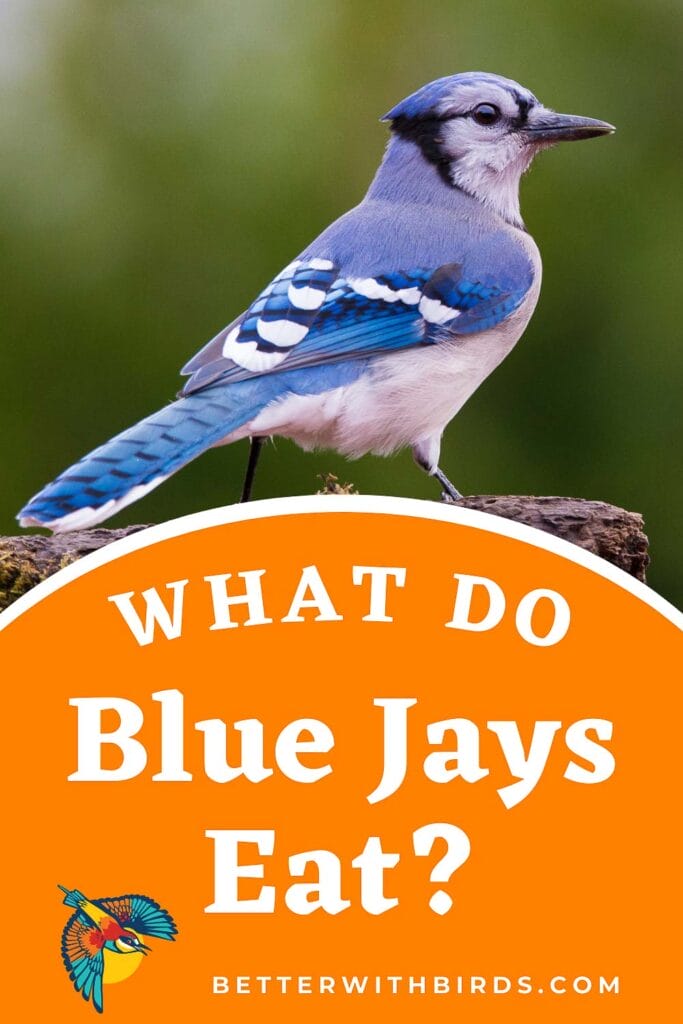
PIN THIS FOR LATER
Contents
Blue Jays eat mostly acorns and other nuts, seeds, and grain. Insects come next, then fruit and berries, and once in a while a frog, a mouse, or another bird’s egg or nestling.
That ranking comes from the classic USDA stomach studies of the Blue Jay (Cyanocitta cristata), published in 1897 and 1926, in which researchers sorted through what hundreds of wild jays had eaten, one stomach at a time.
Close to three-quarters of the year’s food was plant matter. About a fifth was insects. From October through March, acorns and other wild nuts alone made up about two-thirds of everything they ate.
At a feeder, they go for peanuts, sunflower seeds, and suet. Set those out on a tray, or on a hopper feeder mounted on a post. Small tube feeders with short perches? Those mostly keep them off.

A Blue Jay foraging on the ground among fallen autumn leaves. Photo: Rogney Piedra Arencibia/Shutterstock

The main foods in a Blue Jay’s diet
Blue Jays are omnivores, which means they eat both plants and animals. Across a full year, they work through:
- acorns, beechnuts, hazelnuts, and other wild nuts
- corn and other grains, much of it waste grain left in fields
- seeds, including sunflower seeds at feeders
- insects, especially caterpillars, beetles, and grasshoppers
- wild grapes, blackberries, and garden fruit
- spiders, millipedes, snails, and other small invertebrates
- a frog, salamander, fish, or mouse now and then, plus dead or injured small animals
- the eggs and nestlings of other birds, in small numbers
Nuts sit at the center of all that.
The 1897 report needed just six words to say so: “The jay’s favorite food is mast.” (Mast is the crop of nuts that oaks, beeches, and other trees drop.)
Peanuts, one of their preferred feeder foods, aren’t on the list at all. They aren’t native to North America. Every peanut Blue Jays eat comes from people.
And that last item, other birds’ eggs and nestlings? A small slice of the diet, but a real one. Jays seem to take more of them during their own nesting season.
Nuts, seeds, and grain make up most of the diet
Acorns and other wild nuts are the biggest single food in a Blue Jay’s year.
Both USDA studies put mast at more than 42 percent of everything eaten, and that total covers beechnuts, chestnuts, chinquapins, and hazelnuts along with the acorns.
Corn is the next-biggest plant food, about 18 to 19 percent of the year’s total. The jays in those studies ate most of it in winter and early spring, much of it waste grain picked up off fields.
Then come seeds, taken wherever a wild jay finds them. At feeders, sunflower seeds are a go-to.
Are they picky? About acorns, yes. Blue Jays tend to choose acorns that weevils haven’t gotten into, and in one captive feeding trial, jays handled, opened, and ate sound acorns significantly more often than infested ones.
Insects and Small Prey: Protein Sources
Yes, Blue Jays eat insects, and plenty of them. In the 1926 study, insects made up about 22 percent of the year’s food, which dwarfs every other kind of animal food they ate.
The big three are caterpillars, beetles, and grasshoppers, and each has its season. Beetles turned up mostly in spring, caterpillars ran about a tenth of the food through July and August, and in August, grasshoppers alone made up nearly a fifth of everything eaten.
Spiders, millipedes, snails, and crustaceans all showed up in the 1926 stomachs too.
Bigger prey? Rare. A Blue Jay will take the odd frog, salamander, fish, or mouse, and it eats dead or injured small animals when it comes across them.
In 1897, mice, fish, salamanders, snails, and crustaceans together added up to just over 1 percent of the diet.
Mealworms, live or dried, fit right into this part of the diet, and adult jays may take them from a feeder.
Treat them as a snack for the grown birds, and leave the feeding of baby jays to their parents.
Fruit and Berries: Sweet Treats
Yes, Blue Jays eat fruit and berries, grapes included. Among wild fruits, grapes and blackberries are the ones they eat most.
Still, wild fruit is a minor part of the diet, much smaller than nuts or insects. It came to about 7 percent of the year’s food in the 1926 study.
Garden fruit is more of a summer thing. In that study, jays ate cultivated fruit from June through December, and in July it made up about 15 percent of their food.
Putting fruit out? Plenty of fruit-eating birds will take grapes and raisins. Skip any with preservatives, and toss anything that starts to mold.
How Blue Jays find, open, and store food
Blue Jays forage in trees, in shrubs, and on the ground, gleaning insects (picking them off leaves, twigs, and bark) and gathering nuts and seeds wherever they grow or fall.
Hard foods get the foot-and-hammer treatment. A jay pins an acorn or seed under its feet and hammers it open with its bill.
A lot of what a jay picks up never gets eaten on the spot. It gets cached instead, hidden away to eat later.
How Blue Jays cache acorns for later
A Blue Jay carries food in a pouch in its throat and upper esophagus, and a single trip can move as many as five acorns: two or three in the pouch, one in the mouth, and one held in the tip of the bill.

Hang a jay mid-errand at home. The Blue Jay Wooden Ornament shows one with an acorn in its beak on a winter branch, in double-sided Hinoki wood.
Then it buries them in the ground. That jay grabbing several peanuts at your feeder and flying off? It’s probably stashing them somewhere for later.
In one Virginia study, jays carried off and buried about 133,000 acorns from a stand of pin oaks, roughly 54 percent of the crop, flying an average of about 0.7 mile to bury them and as far as about 1.2 miles.
Do they remember where everything is? Captive Blue Jays found their own caches more often than random searching would, which points to real spatial memory.
Wild jays are another matter. As of a 1996 study, no one had shown a wild jay going back to its own particular caches.
Why a Blue Jay sometimes sounds like a hawk
Blue Jays often imitate hawk calls, the Red-shouldered Hawk’s above all, and sometimes the Red-tailed Hawk’s too.
What’s it for? The reason isn’t settled. The calls may warn other jays that a hawk is near, or they may be a way to fool other species.
At feeders, a jay sometimes gives a hawk call on the way in, and the other birds may scatter. Not for long, though. Most come right back once the jay starts eating.
Heard a hawk just before a Blue Jay landed? It may well have been the jay.
A guide to birding by ear helps sort the real hawks from the impressions, and it mentions the Blue Jay’s mimicry too.
How Blue Jays behave around food
Feeder bullies? Blue Jays have that reputation, and it’s mostly undeserved. They’re far less aggressive than many other species.
What they do have is a complex social life, built on tight family bonds. Pairs often stay together for life, which puts Blue Jays on the list of birds that mate for life.
Fall makes them easier to spot. Loose flocks form, and varying numbers head south, moving in flocks along the Great Lakes and the Atlantic coast. Across most of the range, though, Blue Jays stay put all year.
The crest shows a Blue Jay’s mood
The lower the crest sits, the calmer the jay.
A jay sitting on eggs, feeding nestlings, or spending time with its mate, family, or flock mates keeps the crest down.
Up means the opposite. When a Blue Jay squawks, that crest is almost always raised.
Who pushes Blue Jays off the feeder
In one Florida study, a whole lineup strongly dominated Blue Jays at feeders: Red-bellied Woodpeckers, Red-headed Woodpeckers, Florida Scrub-Jays, Common Grackles, and gray squirrels.
Northern Bobwhites, Mourning Doves, White-winged Doves, Northern Mockingbirds, and Northern Cardinals sometimes beat them too.
That’s one study in one state, and your feeder may play out differently. Squirrels crowding your jays out? These tips on keeping squirrels out of bird feeders can help.
How Blue Jay parents feed their family
Only the female incubates, and while she sits, her mate brings her every bite she eats.
Once the eggs hatch, the male feeds both his mate and the nestlings for the first 8 to 12 days, and after that both parents bring food, with the male still doing more of it.
Leaving the nest doesn’t end the feeding, either. Young jays stick with their parents and keep getting fed for at least a month, sometimes two.

A Blue Jay holding a peanut in the shell at a snowy feeder piled with peanuts. Photo: Tony Quinn/Shutterstock
How habitat changes what Blue Jays eat
Blue Jays live across eastern and central North America, in a range that keeps spreading northwest, and they’ll use any kind of forest, especially one with oaks.
They turn up more along forest edges than deep in the woods.
Towns and suburbs work for them as well, especially where there are oaks or bird feeders.
Where a jay lives shapes what it eats. An oak-woods jay leans on acorns, while a suburban one with feeders all around has peanuts and sunflower seeds close at hand.
Blue Jays in towns and suburbs
Oaks in yards and parks still feed neighborhood jays. Feeders are the easy extra.
They visit those for seeds, peanuts, and suet.
They scavenge, too. Chicken eggs turned up in 39 of 530 stomachs in the 1926 study, and the author figured much of that was picked up around rubbish heaps. Eggs from a dump are a different matter from eggs taken out of a wild nest.
Blue Jays in oak woods and forest edges
Out in wilder country, they eat acorns, beechnuts, and other nuts, plus insects through the warm months and wild fruit such as grapes and blackberries.
Jays also plant the forest they feed from. An acorn that gets buried and never dug back up can sprout, and the Blue Jay’s fondness for acorns is credited with spreading oak trees after the last glacial period.
Want Blue Jays around years from now? Plant an oak, and in time its acorns will feed future generations of jays.
How the Blue Jay diet changes with the seasons
The menu swings with the weather, toward insects and fruit when it’s warm and toward nuts and grain when it’s cold.
Spring and summer: insects for nesting season
Spring and summer turn Blue Jays into busy insect hunters. Beetles come first, and by July and August, caterpillars and grasshoppers have taken over. Garden fruit joins the menu from June on.
The timing lines up with nesting. Most land birds feed their young mainly on insects for the first few weeks, and spring and summer are when Blue Jays raise theirs.
You can help with that part. Grow native plants for birds in your yard, and they’ll support the insects jays hunt all summer.
Fall and Winter: Storing Up
In fall and winter, Blue Jays live mostly on acorns and other nuts. Much of the fall goes to burying them for later.
Mast made up about two-thirds of their food from October through March in the 1926 study, and the 1897 numbers show that share climbing as fall goes on, from 64 percent in October to 82 in November and 83 in December.
Corn, much of it waste grain, is the other big cold-weather food.
How big does a jay’s stockpile get? Huge. Six radio-tagged Blue Jays each buried 3,000 to 5,000 acorns in a single autumn.
Winter still has insects on the menu, too. In the cold months, jays go looking for the egg masses of tent caterpillars.
Blue Jay diet by the numbers
Most of the figures on this page come from two USDA reports on what wild Blue Jays had in their stomachs.
One looked at 292 birds in 1897 and the other at 530 in 1926. The 1926 birds came from 30 eastern states and Canada, collected in every month of the year.
Yes, they’re old. They’re also still the classic diet data for the species, and modern species summaries line up with them.
| Food | Share of the year’s food | When and how |
|---|---|---|
| Acorns and other wild nuts | more than 42% | About two-thirds of the food from October through March |
| Insects | about 22% | Grasshoppers nearly a fifth of the food in August |
| Corn | about 18 to 19% | Mostly winter and early spring, much of it waste grain |
| Wild fruit | about 7% | Wild grapes and blackberries lead |
| Garden fruit | no yearly figure | June through December, about 15% of the food in July |
| Other small animals | just over 1% | Mice, fish, salamanders, snails, and crustaceans (1897) |
| Eggs and young birds | found in 1 to 2% of stomachs | Counts birds examined, so it doesn’t compare with the rows above |
Each share is the volume of stomach contents, averaged across the year.
A stomach only shows a bird’s last few meals, though, and every bird came from the East. Read the numbers as the rough shape of the diet.
How much of what modern backyard Blue Jays eat comes from feeders? These studies can’t say.
Where they do help is with a worry plenty of backyard birders share.
Do Blue Jays eat other birds?
Yes, sometimes. Blue Jays eat the eggs and nestlings of other birds and occasionally kill a small bird outright, though all of it adds up to a small part of their diet.
The 1897 USDA study went looking for exactly this. Eggshells turned up in 3 of 292 stomachs, and young birds in 2.
In 1926, the remains of wild birds or their eggs turned up in 6 of 530 stomachs, which puts both studies at about 1 to 2 percent of the jays examined.
Neither author took those numbers as the whole story.
The 1897 report concluded the habit was “not so prevalent as has been believed,” but it didn’t throw out the many eyewitness accounts of jays robbing nests. The 1926 report went further. It called nest robbing “doubtless quite characteristic of the bird under favorable conditions.”
Some jays go beyond eggs. Two of the 1926 birds, collected in February, had each killed a small bird.
There are published reports of Blue Jays killing House Sparrows, a Yellow-rumped Warbler, an adult Cedar Waxwing in Texas, and a fledgling Mourning Dove caught in midair, and jays sometimes pick up dead or dying adult birds as well.
How often does it happen? Individual reports like these can’t tell you, because they don’t add up to a rate.
Nest robbing seems to peak while the jays are nesting themselves. The 1926 records came from May, June, and August.
Researchers count Blue Jays among the common nest predators.
What share of songbird nest losses they cause is a separate question, and the stomach studies can’t answer it. That 1 to 2 percent is a share of jay stomachs. A share of robbed nests would be a different number entirely.
Nest cameras give a glimpse of who does the raiding.
In one Pennsylvania study, cameras on Veery nests filmed 40 raids. Mammals made three-quarters of them and birds a fifth, and the published summary doesn’t say how many of those bird raids, if any, were Blue Jays.
How to feed Blue Jays
Start with peanuts, sunflower seeds, or suet. Put them on a tray feeder or a hopper feeder on a post, which Blue Jays prefer to anything hanging.
New to feeding birds altogether? This guide to feeding backyard birds covers the basics.

Want a pocket field guide you can wear? The Backyard Birds T-Shirt puts the Blue Jay among eight labeled watercolor backyard birds. There’s a Backyard Birds Women’s T-Shirt too.
Peanuts
Peanuts work in the shell or shelled, and either way a jay may grab several at once and fly off to hide them. Botanically, a peanut is a legume. The jays don’t seem to mind.
- Raw or roasted, both are fine.
- Skip salted peanuts and any with coatings or flavorings.
- Check peanut hearts (small peanut pieces sold as bird food) for mold, and throw out moldy ones right away.
Seeds, corn, and suet
Sunflower seed, black-oil or hulled, is the other easy pick. Blue Jays also take cracked corn, safflower, millet, and milo, and cracked corn makes particular sense for a bird that eats so much grain in winter.
Suet draws them as well. Plain suet can go rancid in hot weather unless it’s been specially processed, so stick to processed cakes in summer or save suet for the cooler months.
A feeder with room for a jay
Blue Jays are big birds, 9 to 12 inches long. Short perches on small feeders keep them out.
They need room to land. A tray feeder, which is simply any flat, raised surface you spread food on, gives them plenty.
A large hopper on a post works too, since it’s a roofed box that keeps the seed out of the weather, and the bigger ones have room for a bird a jay’s size.
Give a tray drainage holes and, if you can, a roof to keep the seed dry. Shopping for the post? This roundup of the best bird feeder poles compares the options.
What about tube feeders? A large one sometimes works. The small tubes with short perches are the problem.
Water and clean feeders
Add a birdbath, too. Blue Jays often stop for a drink, and some will bathe. Change the water every couple of days.

A wet Blue Jay bathing in a backyard birdbath. Photo: Jillian Cain Photography/Shutterstock
Clean seed and suet feeders every week or two, more often in busy stretches or wet weather. Trays most of all. Birds eat right off a surface that collects their droppings.
Blue Jay food and feeding FAQ
What is a Blue Jay’s favorite food?
In the wild, acorns and other nuts.
They were the biggest single item in the classic USDA stomach studies across the whole year, and about two-thirds of the food from October through March. At feeders, the foods Blue Jays prefer are peanuts, sunflower seeds, and suet.
Do Blue Jays eat peanuts?
Yes, and peanuts rank among their preferred feeder foods. In the shell or shelled, raw or roasted, they’re all fine as long as they aren’t salted or flavored. Throw out any peanut pieces that start to mold.
Is it good to have Blue Jays in your yard?
For most backyard birders, yes.
They eat caterpillars, beetles, and grasshoppers. They bury acorns that can grow into oaks, and at feeders they’re far less aggressive than their reputation suggests. The trade-off is that they take some eggs and nestlings, apparently most of all during their own nesting season.
How do you befriend Blue Jays?
Give them reasons to keep coming back.
Peanuts in the shell on a tray or a hopper feeder on a post make a good start, and a birdbath with fresh water, plus an oak if you have room to plant one, gives them even more reason to stick around.
Don’t be surprised when they grab a few peanuts and fly off to hide them.
What do baby Blue Jays eat?
Whatever their parents bring them. The parents feed their young in the nest and keep at it for a month or two after they leave.
Found a young jay on the ground? It may not be abandoned.
Nestlings can wander up to 15 feet from the nest just before they fledge, and if you put it back in or near the nest, the parents will keep feeding it. If it’s hurt, call a licensed wildlife rehabilitator.
From the BWB shop, for the Blue Jay watcher
Blue Jays are corvids, in the same family as crows, so Blue Jay fans will find two pieces in the Corvids collection: a wooden ornament and a vintage-style cross-stitch pattern. The Blue Jay is also one of the eight birds on the Backyard Birds T-Shirt.


Browse the Corvids collection or all the gifts for bird lovers.
Want to catch them at the feeder? A bird feeder camera records every visit.
Free tool from Better With Birds: Enter your ZIP and see which birds are likely at your feeder this month. It runs on public bird-occurrence records, and it’s free with no email.