

Owl Facts: 15 Fun Facts About How Owls Hear, See, and Hunt

This post contains affiliate links. If you use these links to buy something, I may earn a commission at no additional cost to you. I only recommend products I fully support or use myself. My full terms
PIN THIS FOR LATER

Contents
There are about 250 owl species in the world, found on every continent except Antarctica, and about 19 of them live in North America.
Every owl is a raptor, a bird of prey with a hooked bill and sharp talons.
What sets owls apart is how they hunt. Many find prey by sound, often in the dark, on wings built to stay quiet.
Some of the most repeated owl facts stretch the truth.
An owl can’t turn its head all the way around. Its eyes aren’t frozen in place, though they barely move, and its night vision is a lot closer to yours than its reputation suggests.
Some aren’t even night owls.
The true versions turn out stranger than the myths. One owl screams instead of hooting, and another may sit on its frozen leftovers the way it would sit on eggs, warming them until they thaw.

Photo: Kelp Grizzly Photography/Shutterstock
A male Great Horned Owl leaning forward with his white throat puffed out as he starts to hoot. Owls call to claim a territory and to attract a mate.

1. Not every owl hoots
The Barn Owl doesn’t hoot at all. It screams, hisses, grunts, and snaps its bill.
The Eastern Screech-Owl gives a shaky, descending whinny and a trill, and despite the name, it doesn’t screech.
The Northern Saw-whet Owl owes its name to a sound that reminded settlers of a saw being sharpened on a whetstone, though the song you’re most likely to hear from one is a plain, long series of toots.
Owls call to hold a territory and to attract a mate, and a female responds only to males of her own species. Size gives you a rough rule. Big owls hoot. Small owls toot.
The Great Horned Owl gives the low hoo, hoo-hoo, hoo, hoo most people picture. Birders often remember it as “Who’s awake? Me too!”
The Barred Owl’s call sounds like a question: “Who cooks for you? Who cooks for you all?” The guide to bird song mnemonics collects more memory tricks like this one.

A Barred Owl, the “Who cooks for you?” caller, perched on a lichen-covered branch and peering down with dark eyes. Photo: G. Parekh/Shutterstock
2. Owls can turn their heads about 270 degrees
All the way around? No.
An owl can turn its head through about 270 degrees, roughly three-quarters of a circle, which is impressive and still well short of the full spin cartoon owls manage.
Some of that reach comes from the neck itself, which has 14 vertebrae (you have seven). The bigger puzzle is blood. How does an owl twist that far without pinching off the supply to its brain?
Researchers who studied owl necks found four adaptations that keep the blood moving.
The bony holes the vertebral arteries thread through are about 10 times wider than the arteries themselves, which leaves slack for the twist, and the vertebral artery enters the neck relatively high, at the 12th of those 14 vertebrae.
Small connections between the carotid and vertebral arteries let blood cross from one to the other.
The fourth is the clever one. Just under the jaw, at the base of the head, vessels can swell into little reservoirs that pool blood for the brain and eyes while the head is turned.
All that neck makes up for eyes that barely move.
Owl eyes are tube-shaped and held in a rigid casing in the skull, and a Barn Owl can move its eyes only about 2 degrees. Looking anywhere else takes the whole head.

Photo: Jaymi Heimbuch
A Short-eared Owl flying low over dry grass, its long wings raised mid-beat. Large wings let owls fly slowly, which helps keep most of them quiet.
3. Most owls fly almost silently
A Barn Owl can fly as slowly as about 2 mph. Big wings make that possible, letting an owl glide along at a crawl, and a slow glide makes very little noise.
The feathers handle the rest. A comb of tiny serrations runs along the leading edge of the wing and breaks up the turbulence that would otherwise make noise.
The upper surface of the feathers is soft and velvety, which muffles sound even more. At the trailing edge, the feathers end in a loose, soft fringe.
Two explanations for all this quiet have good support, and a study comparing 70 owl species found evidence for both of them: prey can’t hear the owl coming, and the owl can keep listening for prey while it flies.
Some owls aren’t built for silence, though. Fish-eating owls have narrower combs, the Tawny Fish-Owl and the Burrowing Owl have little or no comb at all, and owls that are active by day tend to carry fewer of these quieting features.

Photo: Chamois huntress/Shutterstock
A Snowy Owl’s thickly feathered feet gripping a weathered log, black talons out. Like other owls, it can swing one outer toe forward or back.
4. Owls have a reversible toe
How many of an owl’s toes point forward? Depends on the moment. The outer toe on each foot is reversible, free to face the front or swing around to the back.
Swung back, it leaves two toes in front and two behind, an arrangement called zygodactyl (zy-go-DAK-til).
Swung forward, it gives the owl three toes in front and one behind. Because owls switch between the two, semi-zygodactyl is the more precise term, in case it ever comes up at trivia night.
Either way works for perching and for grabbing prey.
That grip is how an owl kills. The talons clamp down on prey and crush it.
Look back at the Snowy Owl in the photo above and you’ll see feathers running all the way down to the toes.
Snowy Owls aren’t alone in that. Across American owls, the most heavily feathered feet tend to belong to species from cold, humid climates.

Stitch an owl of your own with the Barn Owl Cross Stitch Pattern.

Photo: Nataliia Melnychuk/Shutterstock
A Long-eared Owl with its feather tufts standing straight up. Those “ears” are just feathers. Camouflage while roosting by day is the leading explanation for them, though they may also send signals. The owl’s real ears are openings on the sides of its head.
5. Many owls have one ear higher than the other
Picture the two ear openings on the sides of an owl’s head. In many species, one sits higher than the other, and that lopsided setup lets the owl pinpoint a sound in two directions at once.
How?
Left and right come down to timing. A sound off to one side reaches the nearer ear a split second sooner, and the owl’s brain reads that tiny delay.
For up and down, the height difference does the work.
Because the ears sit at different heights, a sound from above or below arrives a little louder at one ear than at the other, and the owl uses that difference in volume to place the sound.
Inside a Barn Owl’s brain, the two cues merge into a map of the space around the bird, left to right and top to bottom.
That map is accurate enough for Barn Owls to catch prey in total darkness, using sound alone.
Lopsided ears aren’t universal among owls. They turn up in some owl groups, the barn owls among them, and the trait evolved separately more than once.
The face pitches in as well. An owl’s facial disc (the round bowl of feathers that frames its face) works like a satellite dish, gathering sound and steering it toward the ears.
In Barn Owls, the ruff (the rim of feathers outlining the face) boosts certain high-pitched sounds by up to about 12 decibels. Owls can also shift their facial feathers a little to adjust the dish.
Stitch that heart-shaped face yourself with the Barn Owl Cross Stitch Pattern, a perched owl ringed with folk flowers.
The Great Gray Owl shows what the whole system can do. In winter it listens for rodents moving under the snow, pinpoints them without seeing a thing, and then plunges in to grab prey that can be more than a foot below the surface.
Curious where any bird keeps its ears? This guide to where bird ears are and how birds hear covers that.
At night, hearing like this carries much of the load. The eyes help, but in the dark they’re less extraordinary than their reputation.

Photo: SunflowerMomma/Shutterstock
A Burrowing Owl tilting its head to stare with big yellow eyes. Burrowing Owls are often active by day, and owls in general see well in daylight.
6. Owl night vision is close to a human’s
In tests of the dimmest light a Barn Owl could detect, the owl scored close to a human. A cat beat it.
Tawny Owls tested slightly better than people, on average, and another estimate puts Barn Owls at about twice as sensitive to light as human eyes. That’s an edge. For a bird famous for seeing in the dark, it’s a modest one.
Rods and cones are easy to get backward, too.
Rods are the retina cells that work in dim light. Cones handle color and fine detail. A human retina holds about 92 million rods and only 4.6 million cones, which works out to roughly 20 rods for every cone.
Owl retinas lean on rods as well, but a Barn Owl has about 10 rods per cone. Your ratio is about double.
Where owls do pull ahead is brightness. Their eyes are huge, together taking up at least 70 percent of the skull’s volume, and a Tawny Owl’s eye casts an image onto the retina about 2.7 times brighter than a human eye does.
Big eyes and a bright image wring the most out of whatever light a night offers. In total darkness, the owl falls back on its ears.

Photo: Susan E. Viera/Shutterstock
An Elf Owl perched in a tangle of desert branches beside a saguaro, its mottled feathers blending into the wood.
7. Owl sizes run from tiny Elf Owls to huge fish owls
The lightest owls weigh about an ounce and a half. The heaviest can reach about 10 pounds.
On the small end sits the Elf Owl, often called the smallest owl in the world.
It measures about 4.7 to 5.7 inches long and weighs roughly 1.5 ounces.
Elf Owls live in the southwestern US and Mexico, hunt at dusk and after dark, and eat mostly moths, beetles, crickets, and other insects, along with scorpions and spiders and, only rarely, a small vertebrate.
One close rival, the Long-whiskered Owlet, is about the same length but heavier.
The big end gets complicated. Which owl counts as “largest” depends on how you measure.
Go by weight, and Blakiston’s Fish-Owl usually gets the title of largest living owl. Females can reach about 10 pounds, and the species measures 24 to 28 inches long.
It lives in the Russian Far East, northeast China, and Hokkaido in Japan, feeds mostly on fish such as salmon, trout, and pike, and is endangered. The Eurasian Eagle-Owl is sometimes considered just as large.
Go by length instead, and North America’s longest owl is the Great Gray Owl, at 24 to 33 inches, though for all that length it still weighs less than a Snowy Owl or a Great Horned Owl.

A Great Gray Owl, North America’s longest owl, perched on a snowy snag and looking back over its shoulder. Photo: Kersti Lindstrom/Shutterstock

Photo: Danita Delimont/Shutterstock
An Eastern Screech-Owl in its gray color form, tucked into a tree cavity with its eyes half closed. Screech-owls nest in cavities like this, too.
8. Most owls don’t build their own nests
Most owls lay their eggs somewhere ready-made, such as an old nest left by another bird, a tree cavity, or a burrow. Snowy and Short-eared Owls just lay theirs in a simple scrape on the ground.
The Great Horned Owl usually takes over an old hawk, eagle, crow, or heron nest and adds little or nothing to it.
Eastern Screech-Owls settle into natural cavities and old woodpecker holes, and they’ll use a nest box, too.
And the Great Gray Owl doesn’t build one either, nesting instead in old goshawk, raven, or Osprey nests or on top of a broken snag, and taking to a platform where people put one up.
Burrowing Owls take the name literally.
In the West they move into burrows dug by prairie dogs, ground squirrels, and other animals, while Florida’s Burrowing Owls usually dig their own.
Then they decorate. Burrowing Owls scatter dung around their burrows, and in one experiment, owls supplied with dung ate about 10 times more dung beetles than owls without it. Most of their diet is insects and small mammals.

An adult Burrowing Owl passing a green caterpillar to one of its two owlets on open ground. Photo: Fine Art Photos/Shutterstock

Photo: kodec/Shutterstock
A pellet of fur and bones lying on moss and pine needles, the kind of bundle owls cough up after a meal.
9. Owls cough up the bones they can’t digest
An owl pellet is mostly fur and bone.
Owls swallow small prey whole and tear bigger prey into pieces, and because they can’t digest the fur or the bones, those parts get packed into a tight bundle and coughed back up later as a pellet.
Owl pellets hold more intact bones than hawk pellets. Why? Stomach chemistry. An owl’s digestive juices are less acidic than a hawk’s, so more bone survives the trip.
For scientists, that’s handy. Pick a pellet apart, and the bones inside show what the owl has been eating.

Photo: Ondrej Prosicky/Shutterstock
A Barn Owl dropping toward pale grass, wings raised and talons reaching. A Barn Owl typically eats three or four small rodents a night, mostly voles in UK studies.
10. Owl diets range from broad to very specialized
Some owls will eat a long list of animals. Others specialize.
The Great Horned Owl is the generalist. Its menu runs through rats, mice, rabbits, ground squirrels, opossums, and skunks, then on to birds as big as geese and hawks, plus snakes and even scorpions, and it will go after porcupines.
There are reports of it taking hatchling alligators.
The Northern Spotted Owl sits at the other end. It specializes in small forest mammals, with northern flying squirrels the main prey in Oregon studies, along with woodrats and red tree voles.
It also depends on old-growth forest. The species is federally threatened, and it’s losing ground to Barred Owls spreading west into its range.

Photo: Keneva Photography/Shutterstock
A Great Horned Owl adult with three owlets in a nest inside a broken tree trunk. Great Horned Owls are among the earliest nesting birds in North America, laying eggs as early as late December in the Southeast and from late February to early April across much of the central US.
11. Baby owls are called owlets
Owlets hatch with their eyes closed, wearing a coat of white down.
For a while, they depend on their parents for everything.
The eyes open after several days. For a Barn Owl, about 10.
Then comes the awkward part. Owlets leave the nest before they can fly and clamber around the nearby branches, flapping as they go, a stage birders call branching.
How long until the first flight? About 4 to 5 weeks after hatching for a Short-eared Owl, and 7 to 10 weeks for Barn and Great Horned Owls.
The feeding doesn’t stop there. Young Great Horned Owls can stay in their parents’ care for up to several months.
Hoping to see a family of owlets? Keep your distance. This guide to finding and photographing owls ethically covers how to watch owls without bothering them.
Recommended: For finding owls near you, start with a field guide. It shows where each species lives and what to look for. This guide to understanding field guides explains how to use one, and my picks for the best binoculars for birding cover optics.

Photo: Ray Hennessy/Shutterstock
A young Great Horned Owl flapping its new wings on a branch as it works toward its first flight. Find a feathered, active owlet on the ground? It’s usually branching, so leave it be and keep pets and people away. If it’s still covered in fluffy down, injured, or in danger, call a licensed wildlife rehabilitator.
12. Some owls hunt in daylight
See an owl hunting in broad daylight? For some species, that’s a normal day.
Snowy Owls often hunt by day, Great Gray Owls hunt by day or by night, and Burrowing Owls do a lot of their hunting in daylight during the breeding season. Others are crepuscular, meaning they’re most active around dawn and dusk.
Owl eyes handle daylight well. They see detail about as sharply as a pigeon does, though they’re weaker at telling colors apart.
13. Great Horned Owls eat smaller owls
Owls end up on other owls’ menus. A Great Horned Owl, the same bird that takes skunks and geese, eats smaller owls as well.
What’s an owl’s worst enemy? For a smaller owl, a Great Horned Owl is a real threat.

Like your owls with a little style? The Art Deco Owl Cross Stitch Pattern turns a Great Horned Owl into clean Art Deco geometry, with bold linework and a restrained palette.
14. Owls stash extra food for later
Owls don’t always eat a kill right away. Extra prey gets cached, tucked away for later.
In a northern winter, that stash can freeze solid, which is why Great Horned Owls may sit on a frozen meal the way they’d sit on eggs, warming it until it thaws enough to eat.
15. Female owls are usually bigger than males
Among owls, the bigger bird of a pair is usually the female, a pattern that holds for Great Horned, Barn, and Barred Owls and gets dramatic in Boreal Owls, where a female can weigh up to twice as much as a male.
Watching a pair of Great Horned Owls side by side? The larger one is most likely the female.
Quick owl facts
- Like all birds, owls have three eyelids. They blink with the upper lid, close the lower lid to sleep, and use the third, the nictitating membrane, to clean and protect the eye.
- Most owls roost alone, though a group of owls is often called a parliament.
- The Great Horned Owl goes by the nickname tiger owl.
- Snowy Owls typically live about 10 years in the wild. One banded wild Snowy Owl made it to nearly 24.
- Some wild owls have lived past 25. Average lifespans are much shorter, and larger species tend to live longer.
- Young Burrowing Owls can make a hiss that sounds like a rattlesnake’s rattle, and ground squirrels react to it almost as strongly as to the real thing.
- Elf Owls almost always nest in old woodpecker holes, many of them in saguaros.
- Can an owl get wet? Yes. Barn Owl feathers aren’t especially waterproof, and Barn Owls avoid hunting in heavy rain.
- A pair of Barn Owls raising young needs almost 4,000 prey animals a year in UK studies, most of them voles.
Want to meet an owl yourself? Start with your ears.
The Great Horned Owl’s “Who’s awake? Me too!” and the Barred Owl’s “Who cooks for you?” are good first calls to learn. Once they stick, step outside on a quiet night and listen.
The guide to learning bird songs by ear can help with the rest.
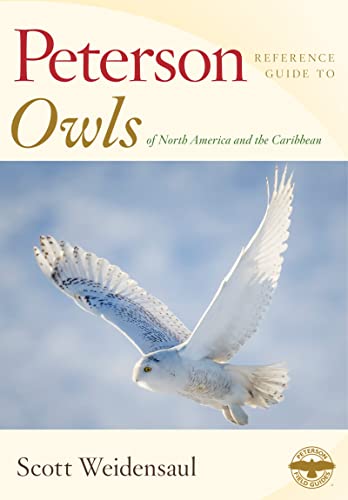
Owl books worth reading
 |
 |
 |
 |
 |
From the BWB shop, for owl fans
Owl fans can stitch two of them: a Barn Owl cross-stitch pattern and an Art Deco Great Horned Owl pattern.