
Raven vs Crow: The Key Differences in These Clever Birds
Feature photo: POUSSINFRANCAIS/Shutterstock
Read Time: 11 minutes
This post contains affiliate links. If you use these links to buy something, we may earn a commission at no additional cost to you. We only recommend products we fully support or use ourselves. Our full disclaimer
PIN THIS FOR LATER
Contents
They're both big. They're both black. And they're both way smarter than they get credit for.
Ravens and crows are the birds most people lump together as "that large black bird in the yard." But once you know what to look for, telling them apart becomes surprisingly straightforward.
The trick isn't finding one magic field mark. It's stacking a few clues together: size, sound, tail shape, behavior, and where you're seeing the bird. Get two or three of those, and you'll have your answer nearly every time.
Unlike the dove vs pigeon situation (where the names are basically interchangeable), ravens and crows are genuinely different species with distinct looks, sounds, and lifestyles.
Here's how to tell these birds apart with confidence.
Raven vs Crow at a Glance
| Feature | Common Raven | American Crow |
|---|---|---|
| Size | 24-27 inches, 1.5-3.5 lbs | 16-20 inches, 11-21 oz |
| Bill | Heavy, curved, with nasal bristles | Smaller, straighter, cleaner |
| Tail shape | Wedge-shaped (diamond point) | Fan-shaped (rounded edge) |
| Flight style | Soars and glides, slow wingbeats | Steady flapping, rarely soars |
| Sound | Deep, throaty croak | Sharp, nasal "caw" |
| Throat | Shaggy, hackled feathers | Smooth, sleek feathers |
| Social behavior | Alone or in pairs | Groups (sometimes hundreds) |
| Habitat | Wilder areas, mountains, forests | Cities, suburbs, farmland |
Each of these differences is useful on its own. Stack two or three together, and you'll rarely be wrong.
Size: The Most Obvious Difference
If you can see both birds side by side, size alone will settle it. But that almost never happens, so you need context clues.
Common Ravens (Corvus corax) are big. Really big. At 24-27 inches long with a wingspan up to 4.5 feet, they're about the size of a Red-tailed Hawk. They weigh 1.5 to 3.5 pounds.
American Crows (Corvus brachyrhynchos) are noticeably smaller at 16-20 inches, roughly the size of a large pigeon. They weigh less than half what a raven does, topping out around 21 ounces.
Here's a useful trick: if you see a black bird and your first reaction is "wow, that's a big bird," it's probably a raven. Crows are common enough that your brain has calibrated to their size. Ravens register as unexpectedly large.
Wing shape adds another clue. Ravens have longer, more pointed wings with visible "finger" feathers (the separated primary feathers at the wingtips). Crow wings are broader and more rounded, without those prominent separated feathers. When a bird is soaring overhead, the wing shape combined with tail shape gives you a near-instant answer.


Top: American Crow (Steve Byland/Shutterstock). Bottom: Common Raven (Robert Harding Video/Shutterstock). Notice the raven's heavier bill and shaggy throat feathers compared to the crow's sleeker profile.
Bill and Head: The Close-Up Clues
When you get a good look at the head, the differences are hard to miss.
A raven's bill is massive. It's thick, curved, and looks almost oversized for its head. You'll also notice a tuft of bristle-like feathers at the base of the upper bill (called nasal bristles), which gives the bill area a rough, untidy look.
A crow's bill is smaller, straighter, and cleaner-looking. It's proportional to its head and lacks those shaggy nasal bristles.
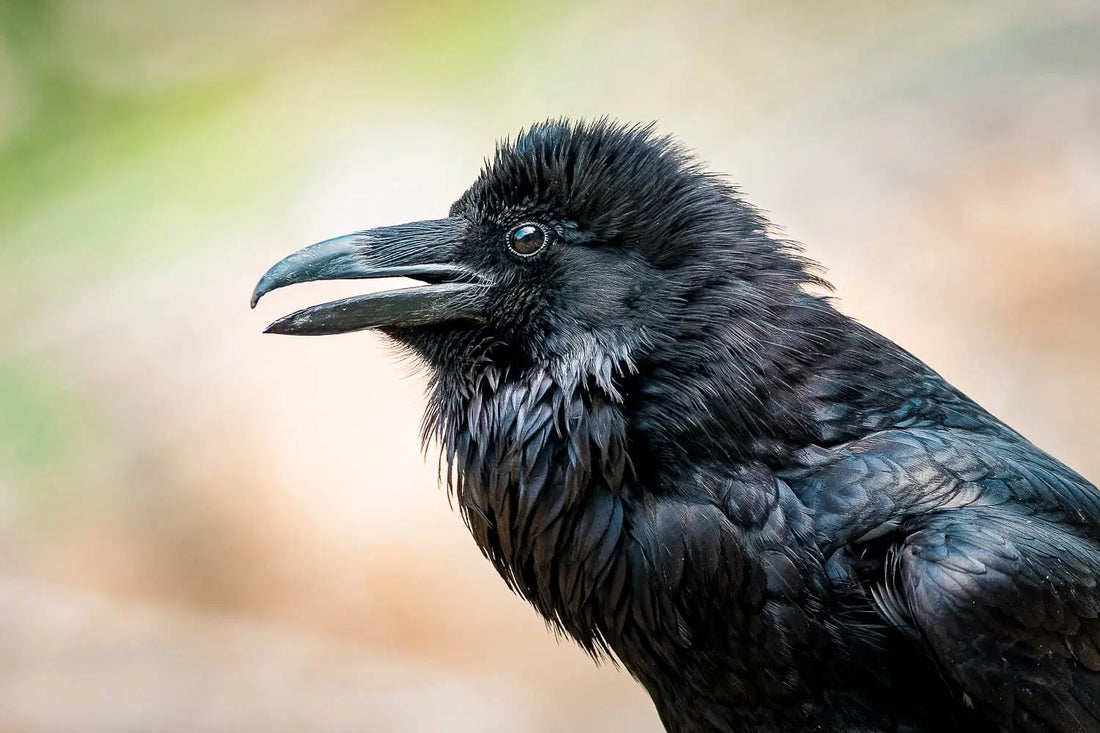
Below the bill, look at the throat. Ravens have elongated, pointed throat feathers called hackles that give them a shaggy, almost bearded appearance. Crows have smooth, sleek throat feathers that lie flat. This is one of the most reliable ID features when you can see the bird up close or through binoculars.
Tail Shape and Flight Pattern
This is the single most useful field mark when you spot a black bird overhead.
A raven's tail forms a wedge shape, like a diamond point or a slice of pie. The central tail feathers are longer than the outer ones, creating that distinctive pointed silhouette.
A crow's tail fans out evenly. The feathers are roughly the same length, creating a rounded or straight-across edge when spread. Think of the difference between a pointed leaf and a rounded leaf.


Top: Common Raven in flight (POUSSINFRANCAIS/Shutterstock). Bottom: American Crow in flight (Paul Reeves Photography/Shutterstock). Compare the raven's wedge-shaped tail with the crow's rounded fan tail.
Their flight styles are different too. Ravens soar. They catch thermals and glide for long stretches with slow, deliberate wingbeats, similar to how a hawk or eagle flies. They also love to play in the air, doing barrel rolls, tucking their wings into dives, and generally showing off.
Crows flap. Their wingbeats are steady and businesslike. They rarely soar for more than a second or two. If you see a large black bird riding a thermal without flapping, that's a raven.
Sound: The Easiest ID When You Can't See the Bird
Sound might actually be the most reliable way to tell these birds apart, especially in wooded areas where you hear them before you see them.
American Crows make that classic "caw-caw-caw" that most people associate with any large black bird. It's sharp, nasal, and relatively high-pitched. When a group of crows starts calling, it's unmistakable, loud, insistent, and a little bit aggressive.
Common Ravens sound completely different. Their signature call is a deep, resonant "cronk" or "pruk" that carries across open landscapes. It's lower-pitched and more hollow than a crow's caw. Ravens also have an impressive range of other vocalizations: knocking sounds, bell-like tones, and even mimicry. In captivity, some ravens have learned to imitate human speech.
Here's a simple way to remember it: crows caw, ravens croak. If the sound is sharp and nasal, it's a crow. If it's deep and resonant, like someone cleared their throat into a microphone, it's a raven.
One more sound to listen for: wing noise. When crows take off, you'll hear the typical rush of feathers. Ravens produce a distinctive, almost musical whooshing sound from their wings in flight, especially during display. On calm days, you can hear a raven flying overhead before you see it.
Social Behavior: Murders vs Loners
Where there's one crow, there are usually more. Crows are deeply social birds that travel, feed, and roost in groups. A group of crows is famously called a murder, and communal roosts can number in the hundreds or even thousands during winter. They call out to each other constantly, share information about food sources, and mob predators as a team.
Ravens are more reserved. You'll typically see them alone, in pairs, or in small family groups. They do sometimes gather at large food sources (like a carcass), but they don't form the massive social flocks that crows do.
So if you see a loose flock of large black birds moving through your neighborhood, they're almost certainly crows. A solitary black bird soaring over a ridgeline? More likely a raven.

Speaking of murders...
Our Attempted Murder T-shirt is a favorite among crow fans. Soft, garment-dyed, and guaranteed to get a laugh from anyone who knows their corvid terminology.
Intelligence: Both Are Remarkably Smart
This is one area where ravens and crows are more alike than different. Both are among the most intelligent animals on the planet, not just among birds.
Ravens have demonstrated the ability to plan ahead, solve multi-step puzzles, and use tools. They remember individuals who've cheated them and adjust their behavior accordingly. They've been observed hiding food, then re-hiding it when they realize another raven was watching.
Crows are equally impressive. Studies have shown their problem-solving abilities are comparable to those of a seven-year-old child. They recognize individual human faces (and hold grudges against people who've wronged them), use cars to crack nuts by dropping them in traffic, and teach their young about specific dangers.
Both species also play, which is a hallmark of intelligence in any animal. Ravens will slide down snowy rooftops repeatedly for no apparent reason other than fun. Crows have been filmed sledding down hills on jar lids.
Their intelligence is one reason both species have thrived alongside humans. They learn fast, adapt to new situations, and pass knowledge to their young. If you regularly feed crows in your yard, they'll learn your schedule. Some people have even developed ongoing "gift exchange" relationships with local crows, leaving food and receiving small objects in return.

Photo: Olinchuk/Shutterstock
Habitat and Range
Where you're standing when you see the bird is a surprisingly helpful clue.
American Crows are the urban and suburban bird. They thrive wherever humans have altered the landscape: cities, farmland, parks, and neighborhoods. They like open areas with nearby trees for roosting. If you're in a parking lot, a residential street, or a city park, the large black bird you're looking at is almost certainly a crow.
Common Ravens prefer wilder, more open landscapes. Mountains, forests, deserts, coastlines, and rural areas are their territory. They're expanding into some suburban areas (especially in the western U.S.), but they're still far less common in dense urban environments than crows.
There's a geographic component too. Ravens are found across the Northern Hemisphere: throughout Canada and Alaska, the western U.S., northern New England, and the Appalachians. Crows are widespread across nearly all of North America. In much of the eastern U.S. and the Midwest, you'll see crows regularly but ravens rarely or not at all.
That said, raven range has been expanding. They're increasingly showing up in suburban areas and even some cities, especially in the West. If you live in Colorado, Montana, or the Pacific Northwest, you might see both species in the same neighborhood. In those overlap zones, stacking your clues becomes especially important.
Identifying Juveniles
Young ravens and crows can be trickier to identify than adults because the size difference is less obvious. A juvenile raven might look closer in size to an adult crow, which throws off the most useful field mark.
Here's what to look for with younger birds:
- Mouth color: Juvenile crows and ravens both have pinkish mouth interiors that darken with age. This won't help you tell species apart, but it confirms you're looking at a young bird.
- Feather quality: Juvenile feathers look slightly duller and less glossy than adult plumage. Young ravens already show the beginnings of shaggy throat hackles, though they're less pronounced than in adults.
- Begging behavior: Recently fledged birds of both species follow their parents around making raspy begging calls. A begging raven still sounds deeper and more guttural than a begging crow.
- Tail shape still works: Even in juveniles, the wedge vs fan tail shape is reliable. If you can see the bird in flight, this remains your best clue regardless of age.
When in doubt with a younger bird, fall back on sound and tail shape. Those two features are consistent across all age groups.
Diet: Both Are Opportunists
Ravens and crows are both omnivores, and neither is particularly picky.
Ravens lean more toward carrion and larger prey. They'll eat roadkill, raid other birds' nests, and hunt small mammals, reptiles, and amphibians. Their heavier bill makes them better equipped for tearing into tough food sources.
Crows eat more seeds, fruits, nuts, and earthworms, supplemented with whatever else they can find. In urban areas, that means a lot of human food scraps. They're the ones picking through fast-food wrappers in the parking lot.
Both species cache food, hiding surplus for later. And both are smart enough to remember where they put it, sometimes returning to a stash weeks later.
If you have a bird feeder camera, you might catch crows visiting your yard, especially if you offer peanuts, sunflower seeds, or suet. Ravens are less likely to visit feeders but have been known to stop by in rural and mountain areas where feeders are near wilder habitat.
What About Other Corvids?
In North America, the Common Raven and American Crow are the two you'll encounter most often. But a few other corvids can cause confusion:
- Fish Crow: Slightly smaller than an American Crow and found mainly in the southeastern U.S. near water. Its nasal, two-noted "uh-uh" call is the easiest way to tell it from an American Crow.
- Northwestern Crow: Previously considered a separate species, now lumped with American Crow. Found along the Pacific Northwest coast.
- Chihuahuan Raven: Smaller than a Common Raven, found in the arid Southwest. It has white feather bases on its neck (visible only when the wind ruffles them).
If you're in an area where multiple corvid species overlap, sound is your best friend for sorting them out. A good field guide or birding app with audio playback can be invaluable for learning the subtle vocal differences between these closely related species.
Frequently Asked Questions
Here are the questions we hear most often about these two birds.
Are ravens and crows the same species?
No. They're in the same genus (Corvus) and family (Corvidae), but they're distinct species. The Common Raven is Corvus corax and the American Crow is Corvus brachyrhynchos. They cannot interbreed.
Can ravens and crows live in the same area?
Yes, their ranges overlap in many parts of North America, especially in the West and in northern regions. Where both species occur, ravens tend to stick to wilder areas while crows dominate urban and suburban spaces.
Which is smarter, a raven or a crow?
Both score extremely high on animal intelligence tests, and scientists generally consider them comparable. Ravens may have a slight edge in planning and problem-solving complexity, while crows excel at social learning and adapting to human environments. It's a close contest.
Are crows or ravens more aggressive?
Crows are more aggressive in groups, especially when mobbing predators or defending territory. They'll gang up on hawks, owls, and even lone ravens. Ravens are larger and can dominate one-on-one encounters, but they don't have the crow's strength in numbers.
Why do crows gather in such large groups?
Communal roosting is a safety strategy. More birds means more eyes watching for predators, more shared body heat on cold nights, and better information about food sources. Some winter roosts can include tens of thousands of crows.
Do ravens really play?
Yes, and it's well documented. Ravens have been observed sliding down snowy slopes, hanging upside down from branches, dropping and catching objects mid-flight, and playing tug-of-war with other animals. Play behavior is considered a sign of advanced cognition.
I saw a large black bird at my feeder. Raven or crow?
Almost certainly a crow. Crows regularly visit backyard feeders, especially for peanuts, suet, and sunflower seeds. Ravens are possible at feeders in rural or mountain areas but very unlikely in suburban settings. Listen to its call to confirm: a sharp "caw" means crow, a deep "cronk" means you have a rare raven visitor.
The bottom line: ravens are bigger, deeper-voiced, shaggier, and prefer wilder places. Crows are smaller, sharper-sounding, sleeker, and love being around people. Stack a couple of those clues together, and you'll get it right almost every time.
Once you start noticing the differences, you won't be able to un-see them. That hulking black bird soaring over the canyon with a wedge tail and a deep croak? Raven, no question. The mob of noisy black birds chasing a hawk across the parking lot? Crows being crows.
If you enjoyed this comparison, the dove vs pigeon question is another fun case of two birds that people constantly mix up. And if you want to sharpen your backyard bird ID skills in general, check out our tips for identifying birds.