

Raven vs Crow: The Key Differences in These Clever Birds

This post contains affiliate links. If you use these links to buy something, I may earn a commission at no additional cost to you. I only recommend products I fully support or use myself. My full disclaimer
PIN THIS FOR LATER
Contents
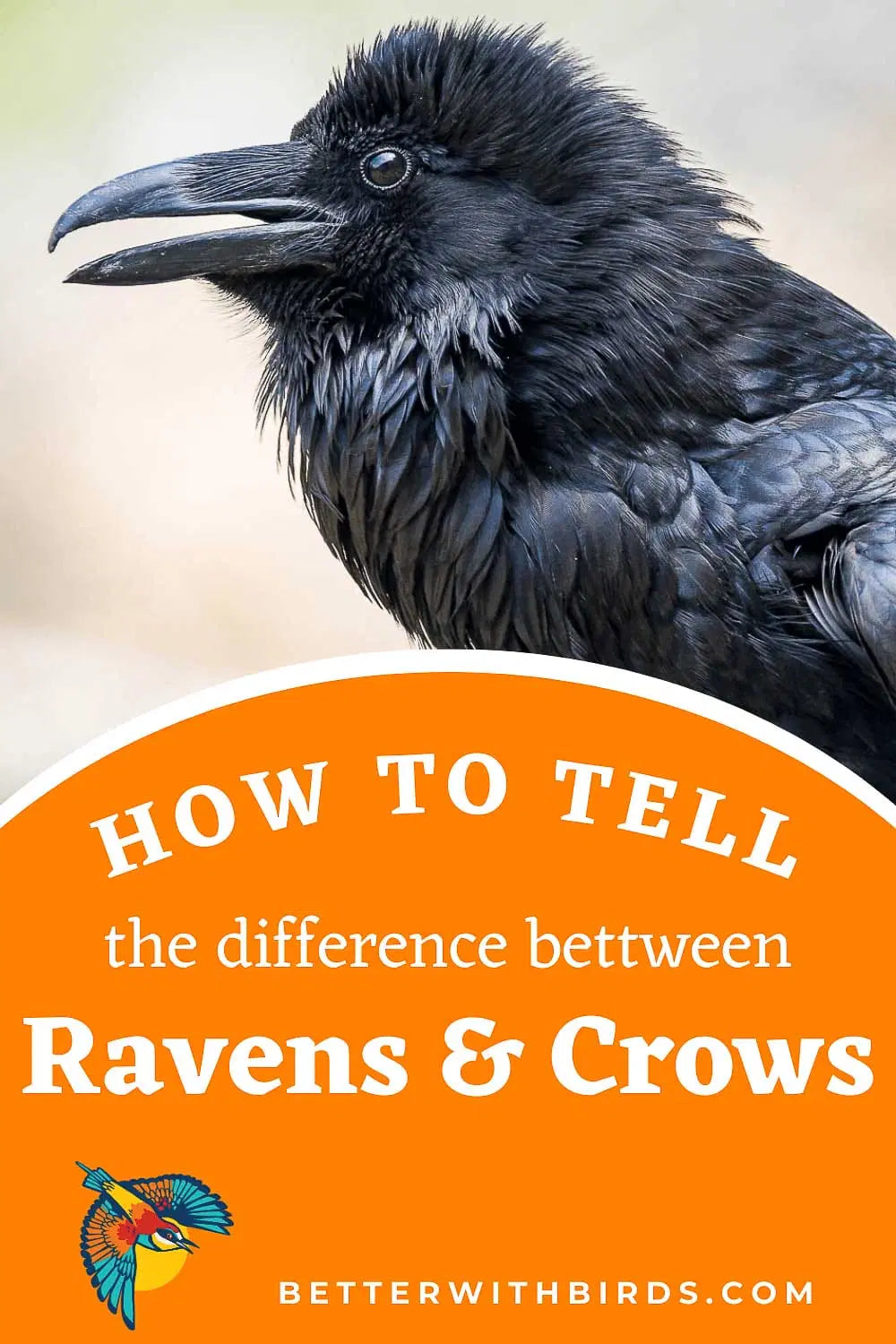
Ravens and crows are different species, and three clues tell them apart.
If the bird is overhead, look at the tail, which is wedge-shaped on a Common Raven and a rounded fan on an American Crow.
Calling from somewhere you can’t see? Ravens croak, crows caw. Size is the third clue and the shakiest, since it only works when something nearby gives you scale.
Both are corvids, members of the crow family along with jays and magpies, and scientifically the two names don’t mean much, since “raven” is just the name that tends to stick to the biggest black species, usually the ones with shaggy throats.
Four crows and ravens are widespread in the US. Alongside the Common Raven and the American Crow, there are two regional look-alikes: the Fish Crow in the East and Southeast, and the Chihuahuan Raven in the Southwest.
None of these marks works every time, which is why it pays to stack two or three before you decide.
Ravens and crows at least sort more cleanly than the pair in the dove vs pigeon comparison, where the two names often land on the same birds.
Not sure ravens even live where you are? They’re rare or missing across most of the Great Plains, the Midwest farm belt, and Florida. The range table further down names the states.
A broader method, one that works on any bird, starts with these tips for identifying birds.

Raven vs crow at a glance
| Feature | Common Raven | American Crow |
|---|---|---|
| Size | 22 to 27 in, 24 to 57 oz (1.5 to 3.6 lb) | 16 to 21 in, 11 to 22 oz |
| Wingspan | About 46 in (3 ft 10 in) | 34 to 39 in (about 3 ft) |
| Bill | Huge and deep, long bristles far along the top | Smaller, with shorter, neater bristles |
| Throat | Shaggy, long pointed feathers | Smooth |
| Tail shape | Wedge or diamond shape | Rounded or squared-off fan |
| Wings | Long and narrow, long thin “fingers” (spread wingtip feathers) | Broader and rounder, shorter fingers |
| Flight style | Soars and glides often, slow wingbeats | Steady rowing flaps, rarely glides |
| Sound | Deep, gurgling croak | Harsh caw |
| Social behavior | Alone or in pairs. Young birds gather at food | Families and flocks. Winter roosts up to two million |
| Habitat | Deserts, mountains, forests, coasts, some western towns | Farmland, suburbs, parks, cities |
| Range | Alaska and the West, upper Great Lakes, Northeast, Appalachians | Most of the lower 48 except southwestern deserts |
Which rows you need depends on distance. For a bird overhead, it’s the tail and wings, and for one calling from cover, it’s the voice. Only a bird perched fairly close gives you the bill and throat.
Size: the most obvious difference
Next to each other, the size gap is hard to miss. A Common Raven is about half again as big as an American Crow, roughly the size of a Red-tailed Hawk. You almost never get that view, though.
The largest songbirds in the world are Common Ravens (Corvus corax), a strange title for a bird that croaks.
They measure 22 to 27 inches and weigh about 1.5 to 3.6 pounds, with a wingspan around 46 inches.
American Crows (Corvus brachyrhynchos) are nearly twice the size of a Blue Jay, at 16 to 21 inches and 11 to 22 ounces, with a wingspan of 34 to 39 inches.
At the extremes the two come close. The heaviest crows weigh nearly as much as the lightest ravens.

Crow person? Wear one on the American Crow trucker hat.
Size on its own can fool you. Where ravens are scarce, that really big crow is usually just a crow, and any crow with its feathers fluffed out looks bigger than it is.
Shape travels better. A flying raven looks longer in the neck, with longer, narrower wings and a longer tail, and because those are proportions rather than measurements, you can read them even when there’s nothing nearby to give you scale.


Top: an American Crow standing in short grass, smooth-throated and slim-billed. Photo: Steve Byland/Shutterstock. Bottom: a Common Raven perched on a lichen-covered rock, showing its shaggy throat and heavy bill. Photo: Robert Harding Video/Shutterstock.
Bill and head: the close-up clues
The bill comes first once a bird is perched close enough for binoculars. A raven’s is long, deep, and heavy, big enough to look a size too large for its head.
Both species have nasal bristles (stiff feathers over the nostrils at the base of the bill).
On a raven they run longer and shaggier and reach farther down the bill, while a crow’s stay short and neat, which leaves its bill looking cleaner.
Don’t lean on the curve of the bill, though, because descriptions disagree about which bird’s curves more. Go by length and depth.
Below the bill, check the throat. Ravens wear hackles (long, pointed throat feathers) that give them a shaggy, bearded look, and they raise them when squaring off with another bird.
A crow’s throat just lies smooth, so if your binoculars show a huge bill sitting over a shaggy throat, that’s about as close to a sure call as this pair allows.
Tail Shape and Flight Pattern
Wedge-shaped tail overhead? Raven. A rounded or squared-off fan means crow.
On a raven the middle tail feathers are the longest, so a spread tail tapers to a point, like a diamond tip or a slice of pie.
A crow’s tail feathers all run close to the same length, and the tail opens into an even fan. What if the tail looks pointed in summer? A crow in molt can briefly show one.


Top: a Common Raven in flight, wings spread wide and tail fanned. Photo: POUSSINFRANCAIS/Shutterstock. Bottom: an American Crow flying overhead, wingtip feathers spread like fingers and tail opened into a rounded fan. Photo: Paul Reeves Photography/Shutterstock.
Check the wingtips in those photos. Both birds spread their outer flight feathers like fingers, but on a raven the fingers are longer and thinner and sit at the end of long, narrow, swept-back wings.
Ravens also soar (ride rising air without flapping) far more than crows do. Up there they play, rolling and diving with wings tucked and turning somersaults, a move you won’t see a crow make.
If you’d like a tail shot to study at home, a guide to photographing birds in flight will help.
A crow rows along on steady wingbeats and rarely breaks them with a glide. Any black bird soaring for more than a few seconds deserves a second look for raven.
That rule bends in two places. Over southwestern grasslands, a soaring flock may be Chihuahuan Ravens, and in the East, Fish Crows soar too.
On the ground, a raven struts, and now and then it bounds forward in light, two-footed hops.
Sound: the easiest ID when you can’t see the bird
For the four US crows and ravens, voice is usually the best single clue, and it works before the bird comes into view.
An American Crow gives the familiar caw, strong and harsh, but that’s only one of more than 20 calls, which include rattles, clicks, and clear, bell-like notes.

Team caw? Wear the joke on the F-Caw-F Crow T-shirt.
A Common Raven’s usual call is a croak, low and gurgling and rising in pitch, the sound people spell as gronk or wonk-wonk. It can carry more than a mile.
There’s also a rapid knocking call, about a dozen knocks a second. Ravens mimic other birds, too, and captive ones have learned human words.
A crow makes nothing like that croak. Ravens do sometimes give a caw-like call, but it’s far deeper than a crow’s.
Deep and resonant, like someone clearing their throat into a microphone? Raven. To practice before your next sighting, this guide to learning bird calls by ear includes the Common Raven.
In the East and Southeast, a nasal, two-note uh-uh points to Fish Crow, which sounds like an American Crow with a bad cold, and in the Southwest a Chihuahuan Raven’s kraak comes out higher and harsher than a Common Raven’s croak.
Nesting season sets a trap. For their first month or two out of the nest, young birds of all four species sound higher than adults, and young Common Ravens keep it up for a few months.
That means a begging young American Crow can pass for a Fish Crow, and a young Common Raven for a Chihuahuan Raven. A high, nasal caw from a crow trailing its parents? Likely a youngster.
Social behavior
Crows are family birds. Young ones may stay on for years to help raise new broods, and a single family can reach 15 birds.
Winter pulls them into much bigger crowds, communal night roosts of anywhere from a few hundred to about two million birds. Crows also gang up to mob hawks, owls, and herons.
A group of crows has an old poetic name, a murder, though most birders just call it a flock.
Ravens mostly keep to themselves or travel in pairs, and a pair holds its territory together year-round. They got poetic group names too, an unkindness and a conspiracy.
Crowds do form at carcasses, landfills, and night roosts, probably made up mostly of young birds that haven’t paired up yet. A flock of 100 or more isn’t unheard of. Thousands would be rare.
In practice, a loose, noisy flock working its way through a neighborhood is usually crows, while one or two big black birds riding the wind over a ridge are more likely ravens, at least where ravens live.
Big black bird getting chased by a few crows? Bet on raven. Ravens raid crow nests, and crows go after them for it.

Speaking of murders...
Know the old group name for crows and can’t leave the joke alone? The Attempted Murder tee is for you.
Intelligence: Both Are Remarkably Smart
Raven and crow problem-solving gets compared with that of great apes, and both rank among the smartest birds.
Ravens can plan for the future. In one lab study, five captive ravens chose a tool or a trading token they would need later, then used it after delays of 15 minutes to 17 hours, and they picked right more than 70 percent of the time with tools and about 80 percent with trades.
They’re protective of hidden food, too. A raven caching food while others watch may stop, move it, or tuck it out of sight.
In Wyoming, gunshots during hunting season drew ravens in, while equally loud sounds that meant nothing to them did not. The birds had learned what that sound tends to mean.
American Crows remember faces. In one experiment, researchers wore a particular mask while trapping crows, and for more than two and a half years afterward, anyone wearing that mask got scolded.
The grudge spread. Crows that were never trapped learned to scold the mask too, including young crows that picked it up from their parents, and over five years the scolding doubled and spread at least 1.2 kilometers (about three-quarters of a mile).
Crows also crack hard-shelled mollusks by carrying them up and dropping them onto rocks.
Then there’s play. One raven was seen flying upside down for more than half a mile.
Which is smarter, then? The studies above can’t say. They test different skills and never pit the two birds against each other, so there’s no measured answer to give.

A Common Raven in the rain, looking back over its shoulder, its heavy bill and shaggy throat in close view. Photo: Derek Hoinkis/Shutterstock.
Habitat and range
American Crows cover most of the lower 48 and are missing mainly from the hot southwestern deserts. Common Ravens have a patchier map, and it’s still changing.
Where the range data names states, so does the table. Its rare, missing, and unlikely calls are mostly inferred from range descriptions, though, so read them as a strong lean, and check eBird’s live Common Raven range map for your own county.
| Where you are | Common Raven | Other big black corvids |
|---|---|---|
| Alaska and the West: Washington, Oregon, California, Nevada, Idaho, Montana, Wyoming, Utah, Colorado, Arizona, New Mexico | Widespread, from deserts and coasts to mountains. Gaps include parts of the California coast and the open plains east of the Rockies | American Crow in most of the lower-48 West, except hot deserts. Chihuahuan Raven in Arizona, New Mexico, and eastern Colorado |
| Texas | Trans-Pecos (far West Texas) and the Edwards Plateau (west-central Texas), plus one Panhandle breeding record | Chihuahuan Raven in the dry west and south. American Crow in the northeast. Fish Crow on the coast |
| Oklahoma and Kansas | Unlikely. The Great Plains generally lack them | Chihuahuan Raven in western Oklahoma and southwest Kansas. American Crow |
| Plains and Midwest farm belt: Nebraska, the Dakotas, Iowa, Missouri, Illinois, Indiana | Rare or missing in most of the region | American Crow. Fish Crow spreading up the Mississippi Valley |
| Upper Great Lakes: northern Minnesota, Wisconsin, Michigan | Regular in the north | American Crow |
| Northeast: Maine, New Hampshire, Vermont, New York, Massachusetts, Pennsylvania | Regular and spreading. Massachusetts went from 5 breeding-atlas blocks to 327, about a third of the state | American Crow. Fish Crow on the coast and major rivers |
| Appalachians and neighbors: Maryland, West Virginia, Virginia, North Carolina, South Carolina, Georgia, Tennessee, Kentucky, Alabama, Ohio | Common in the mountains, spreading lower, and back in Ohio, Kentucky, Tennessee, and Alabama | American Crow. Fish Crow on the coastal plain and rivers |
| Florida and the Gulf lowlands: Florida, Louisiana, Mississippi, the Southeast coastal plain | Unlikely, going by published range descriptions | American Crow and Fish Crow |
American Crows like open ground with trees nearby, which takes in fields, parks, suburbs, and city streets, and they stay out of deserts, unbroken forest, and high mountains.
Big black bird in an eastern or midwestern parking lot? Almost certainly a crow.
Common Ravens use nearly every kind of wild or open country, deserts and sagebrush, coasts, forests, alpine summits, and tundra among them, and they get along fine around rural homes and small towns.
In parts of the West they’ve moved into cities, Los Angeles included. A big black bird in town out there could be either.
Ravens were gone from most of the East and Midwest before 1900. In parts of that old range they’re coming back, and in the central and southern Appalachians their range grew about 40 percent between 1950 and 2016.
Ohio’s first raven nest in more than a century turned up in Jefferson County.
In Colorado, Montana, or the Pacific Northwest, a raven and a crow can share a neighborhood.
Across most of the country, though, only two of these species overlap in any one place: American Crow with Common Raven, or American Crow with Fish Crow.
Identifying juveniles
The trap with juveniles (birds in their first months out of the nest) is the voice, which runs higher than their parents’ for a month or more.
Some clues mark a bird as young without telling you which species it is.
- Young American Crows have blue eyes that darken with age, pink corners at the base of the bill (the gape), and short tails that make the fan harder to read.
- Ravens look browner when young. Molting crows can look brownish or scaly too, though, so brown by itself settles nothing.
- Crow chicks often leave the nest before they can fly well, and the family keeps feeding them for weeks.
The parents are more useful. Wait for an adult to call or fly, then check its tail, throat, and voice.
Diet: both are opportunists
Neither bird is fussy. Both eat plants and animals and both scavenge, though the mix differs.
Ravens lean toward animal food, which for them means insects, rodents, lizards, frogs, other birds’ eggs and chicks, carcasses, and garbage, but they’ll still take grain, berries, and pet food.
Crows eat earthworms, insects, seeds, grain, nuts, and fruit, with carrion only a small part of the diet. A crow can’t even open a gray squirrel carcass on its own.
That makes a big black bird tearing into a fresh carcass by itself, in raven country, more likely a raven.
Both hide extra food to eat later, a habit called caching.
At bird feeders, crows aren’t regular visitors, although peanuts left out in the open can draw them in. Ravens can be lured with seed or pet food. Standard guidance says not to.
If you want proof of who’s taking the peanuts, start with these picks for the best bird feeder cameras.
What about other corvids?
Jays and magpies are corvids too, but their colors rule them out here. The look-alikes worth knowing are two more black corvids, plus one crow that’s no longer its own species.

Blue Jays count as corvids too. Hang one at home with the Blue Jay wooden ornament.
- The Fish Crow is a bit smaller than an American Crow, at 14 to 16 inches. It lives along the Atlantic and Gulf coasts and across the Southeast, spreading inland along big rivers. Only its voice names it for sure: a nasal kwok or a two-note uh-uh.
- The Chihuahuan Raven is about crow-sized (18 to 20.5 inches) and lives in Southwest grasslands, often in flocks of hundreds. When the wind ruffles its neck feathers, you may catch their white bases.
- The Northwestern Crow of the Pacific Northwest coast no longer counts as a species. It interbred so freely with the American Crow that it was folded in, and it’s now a subspecies.
All dark, poking around under the feeder, and smaller than a crow? Think grackle. A Common Grackle runs 11 to 13.4 inches, and no member of the blackbird family is as big as a crow.
For anyone who’s fallen for the whole crow family, the Corvids collection in the BWB shop has crow and Blue Jay designs.
Frequently asked questions
Are ravens bigger than crows? Yes, by a lot. A typical Common Raven weighs about two and a half times what a typical American Crow does.
Are ravens and crows the same species?
No. They’re separate species that share a genus, Corvus. The Common Raven is Corvus corax, and the American Crow is Corvus brachyrhynchos.
Interbreeding is extremely rare but documented. A wild crow and raven pair in Toronto, for one, raised young around 1990.
Can ravens and crows live in the same area?
Yes. They overlap across much of the West and the North, and more and more in the Northeast and the Appalachians. Ravens tend toward wilder country, but some western cities, Los Angeles among them, have ravens right in town.
Which is smarter, a raven or a crow?
There’s no measured answer. Ravens shine at planning and American Crows at learning which people are dangerous, so any ranking comes down to opinion. One longtime crow researcher put it this way: crows are “smarter than many undergraduates, but probably not as smart as ravens.”
Are crows or ravens more aggressive?
Crows, at least when they’re in a group. They mob hawks, owls, and herons, and they chase ravens too, largely because ravens raid crow nests.
Why do crows gather in such large groups?
A winter night roost can hold anywhere from a few hundred to about two million crows. Why they gather is still largely guesswork, though the leading ideas are safety from predators and a chance to share news about food.
Do ravens really play?
Yes. They roll and somersault in flight, and they drop sticks and catch them in midair. People in snowy northern towns report ravens sliding down roofs and going back for another run.
I saw a large black bird at my feeder. Raven or crow?
Start with size, since the feeder gives you something to measure against. Crows run 16 to 21 inches. An all-dark bird about a foot long is usually a grackle or another blackbird, and crows don’t regularly visit feeders, though peanuts can bring them in.
In rural raven country, a raven at the feeder is possible. Elsewhere it’s unlikely. If the bird calls, a deep croak means raven and a caw means crow.
What is a group of ravens called?
The poetic names are an unkindness and a conspiracy. “An unkindness of ravens” goes back to 15th-century lists of group names, while “a conspiracy of ravens” is a much newer coinage. Out in the field, birders just say flock.
What US states have ravens?
Common Ravens live across Alaska and most of the West, from Washington and California to Montana, Colorado, New Mexico, and west and central Texas.
In the East they range through the northern Great Lakes states, New York, Pennsylvania, and New England, then down the Appalachians to Georgia, and they’ve returned to Ohio, Kentucky, Tennessee, and Alabama.
Across most of the Great Plains, the Midwest farm belt, Florida, and the Gulf Coast lowlands, they’re rare or missing. The range table above lists the states region by region.
Wherever you live, two traps are worth ruling out before you call it. The first is size. Where ravens are scarce, a big-looking crow is still a crow, and a raven far off can look crow-sized when nothing nearby gives you scale.
The second is voice, because in nesting season a higher-pitched call may just mean a youngster.
Still not sure? Wait. Sooner or later the bird flies or calls, and a wedge-shaped tail overhead or a deep croak usually settles it.
Two more pairs people mix up get the same treatment in the falcon vs hawk guide and the egret vs heron comparison.
From the BWB shop, for the corvid fan
Find every corvid design in one place: crow shirts and hats, a sticker, a poster, a notebook, and a couple of Blue Jay pieces.


Free tool from Better With Birds: Enter your ZIP and see which birds are likely at your feeder this month. It runs on public bird-occurrence records, and it's free with no email.