
Falcon vs. Hawk: A Birdwatcher’s Guide to Raptor Identification

This post contains affiliate links. If you use these links to buy something, I may earn a commission at no additional cost to you. I only recommend products I fully support or use myself. My full disclaimer
PIN THIS FOR LATER
Contents
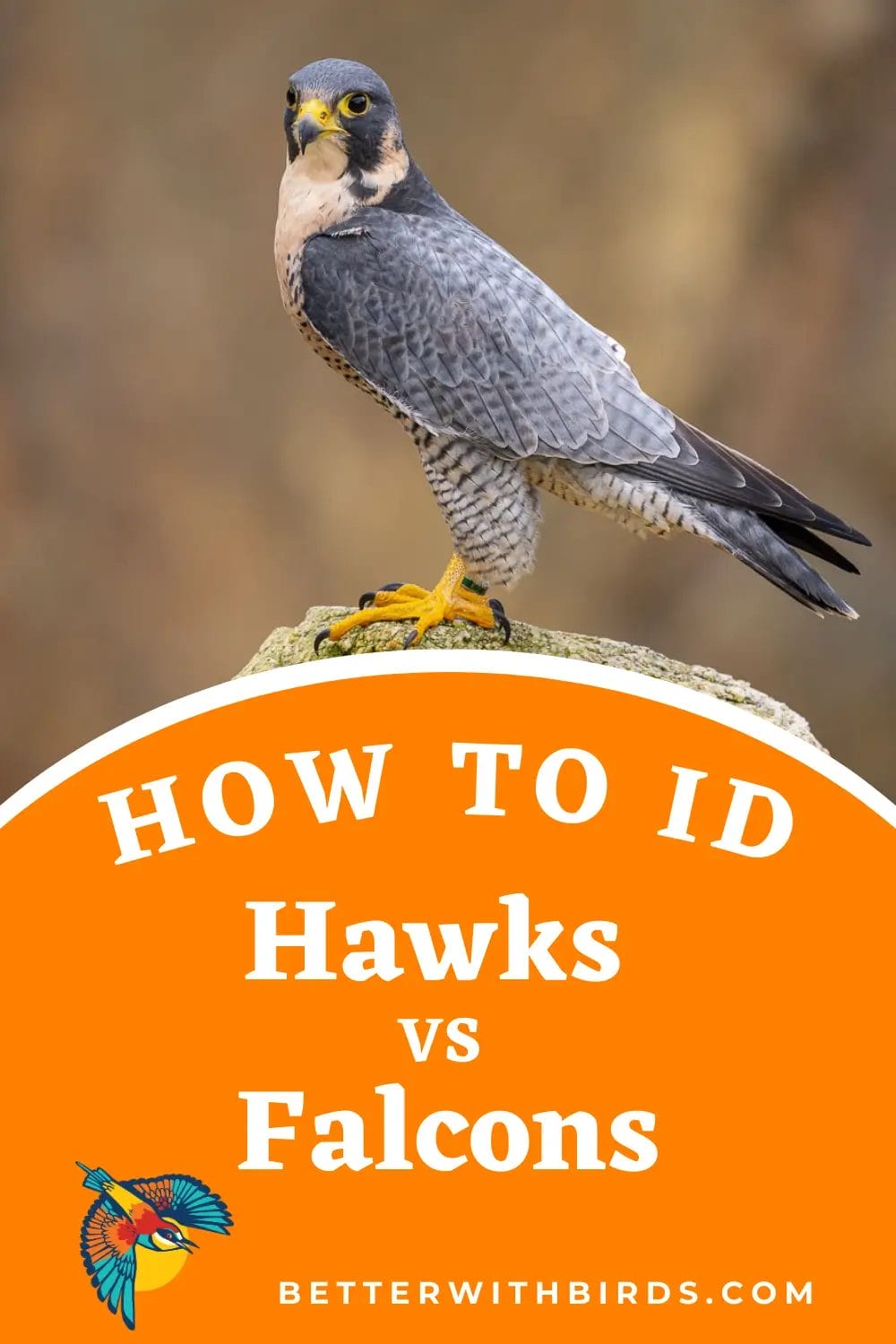
No, a falcon is not a hawk. Falcons belong to the family Falconidae, and hawks belong to a separate family, Accipitridae.
Three things usually settle it in the field. A falcon has long, pointed wings and flies with fast, steady wingbeats. And most falcons wear a dark stripe below the eye, called the malar, or “mustache,” mark.
The bigger surprise is how far apart the two really are. A large 2008 DNA study found that falcons are closer kin to parrots and songbirds than to hawks, and the official checklist of North American birds now lists falcons right next to the parrots, just ahead of the songbirds.
The resemblance most likely comes down to the job. Catching live prey rewards a hooked bill, sharp talons, and keen eyes, so both groups ended up with the same kit.
That kit is what makes both of them raptors, the umbrella word for birds of prey. Eagles, ospreys, and owls count too.
Old names muddied things further. Several North American falcons used to go by hawk names: the American Kestrel was the sparrow hawk, the Merlin the pigeon hawk, and the Peregrine Falcon the duck hawk.
You won’t need DNA to sort them out in the field. A decent look at the wings, the wingbeat, the tail, and the face will do it.
*Caveat! *These are general traits, and there’s loads of variation from one hawk or falcon species to the next. Study up using field guides to dial in the details.

Photo: Gerald A. DeBoer/Shutterstock
Sharp-shinned hawks are savvy hunters, often scoping out backyard birdfeeders for an easy meal.

The Quick Answer
At first glance, hawks and falcons look like close relatives. They aren’t. Hawks are in the family Accipitridae, falcons are in Falconidae, and the differences start to show once you look past the hooked bill and the talons.
Hawks are generally the beefier birds, with broader, rounded wings. Many put that muscle into catching small mammals.
The tail depends on the kind of hawk: accipiters (short-winged hawks that ambush birds from cover, like the Cooper’s Hawk) carry long tails, and buteos (broad-winged hawks that soar, like the Red-tailed Hawk) have short, fanned ones.
Falcons usually run smaller, and they’re built for speed. Sleek, pointed wings. Long, narrow tails.
Prey splits by species. The Peregrine and the Merlin chase down other birds, while the little American Kestrel mostly hunts insects and small mammals.
Not always smaller, though. The two groups overlap in size, so size alone won’t settle it.
Watch how the bird moves. Hawks glide more often, while falcons mostly keep flapping, fast and steady.
Stack the clues. Size, wing shape, hunting style, and habitat each narrow it down, and two or three together are usually enough to tell these two apart.
| Feature | Falcons | Hawks: accipiters | Hawks: buteos |
|---|---|---|---|
| Family | Falconidae | Accipitridae, the hawk family | Accipitridae, the hawk family |
| Length, bill to tail | American Kestrel about 9 to 12 in, Peregrine Falcon 14 to 19 in | Sharp-shinned Hawk 10 to 14 in, Cooper’s Hawk 15 to 18 in | Broad-winged Hawk 13 to 17 in, Red-tailed Hawk 17 to 26 in |
| Wings | Long, with pointed tips | Short and rounded | Broad and rounded, with finger-like feather tips |
| Tail | Long and narrow (shorter on a Merlin) | Long | Short and fanned |
| Wingbeat and flight | Fast, steady wingbeats on a direct path. Doesn’t usually soar (kestrels often hover) | A few quick flaps, then a glide (flap-flap-glide) | Soars in wide circles |
| Head and face | Big head, with a dark “mustache” below the eye on most species | Small head, most obvious on the Sharp-shinned Hawk | Go by wings and tail instead |
| Bill and kill | Notched bill (the “tomial tooth”) for a killing bite to the neck | Usually kills with the talons | Usually kills with the talons |
| Hunting | Peregrine dives on birds in the air. Kestrel hovers, then drops on insects and mice | Bursts from cover after small birds | Watches from a perch or circles, then drops on rodents |
| Nest | Usually builds none: a ledge scrape, a cavity or nest box, or another bird’s old stick nest | Stick nest in a tree | Stick nest in a tree, on a cliff, or on a structure |
Every length runs bill tip to tail tip, taken from standard field-guide ranges. Other references shift the numbers a little. Where guides split the sexes, the females run larger.
Shape before color works on any bird, raptors included. The guide to identifying birds by shape, size, and behavior walks through that method in more depth.


Top Photo: Priya S Nair Nature/Shutterstock, Bottom Photo: Richard Seeley/Shutterstock
Notice the difference between the broader wings of a red-shouldered hawk (top), and the sharper wings of the American kestrel (bottom).
Physical Characteristics: Deciphering Falcons and Hawks
Look at the wings first. A falcon’s are tapered and slim, built for agile flight.
Then size, then the tail. Between them, wing shape, size, and tail characteristics can often name the bird before you’ve seen a single color.
Size and Proportions
When it comes to size, hawks generally outsize falcons. A Red-tailed Hawk can run more than 10 inches longer than an American Kestrel or a Merlin, beak to tail.
That rule bends, though. A Cooper’s Hawk can be smaller than a Peregrine Falcon, so check which species you’re actually comparing.
Wing Shape
Falcons, like the Peregrine Falcon, have long, slim, pointed wings built for speed.
Hawks like the Red-tailed Hawk have broader, rounded wings, with finger-like feathers spread at the tips. Those are wings made for soaring.
Accipiters such as the Cooper’s Hawk are the maneuverers. Short, rounded wings let them handle tight turns.
Tail Features
Falcons, such as the American Kestrel, have long, narrow tails. On a Merlin, the tail runs relatively short.
Hawks split two ways. Accipiters like the Cooper’s Hawk have long tails, and buteos like the Broad-winged Hawk have short, fanned ones.
Long tail? That could be a falcon or an accipiter, so check the wingtips before you decide.

Photo: SanderMeertinsPhotography/Shutterstock
Harriers love hunting over open fields, searching out unsuspecting rodents.
Hunting Techniques
Falcons mostly win on speed. Hawks lean more on patience and surprise, and if you get to watch one hunt, that difference is a clue in itself.
Falcons’ Aerial Pursuit
Peregrines and Merlins hunt mostly other birds, using speed and agility to catch them, while the American Kestrel eats mainly insects and small mammals.
A falcon finishes the job with its beak. The upper bill has a notch, the “tomial tooth,” which lets the bird deliver a precise killing bite to the prey’s neck or spine.
Once the falcon has grabbed its catch, that notch helps it immobilize the prey quickly.
The Peregrine Falcon hunts with a dive known as the stoop, climbing high, tucking its wings, and plunging at speeds that can reach around 200 mph to strike prey out of the air.
The strike itself comes from the feet, and the impact usually breaks the prey’s back.
Hawks’ Perch and Ambush Tactics
Most hawks hunt by surprise.
First they have to find the prey, and hawk eyesight is sharp enough to pick it out from a long way off.
One favorite method is “perch hunting.” The hawk sits somewhere high and watches, patiently, for as long as it takes to pick a target, then swoops down.
Where a falcon bites, a hawk mostly kills with its feet. Sharp talons are its main weapon against small mammals, reptiles, and other birds.
A Northern Harrier works differently. It flies low over fields to flush out prey, then ambushes it.
That low flight is a field mark in itself. Wings held in a shallow V, just above a field or marsh? Most likely a harrier, and a white rump patch will confirm it.

Photo: Dennis Jacobsen/Shutterstock
A peregrine falcon in a stoop (dive).
Speed and Flight Patterns
On a distant bird, flight style is often all you get. Falcons are the speedsters. Hawks are the gliders.
Falcons’ Speed
Sleek, pointed wings and a streamlined body give a falcon direct, powerful flight on deep, rapid wingbeats.
Peregrines and Merlins put that speed to work chasing other birds down in midair.
Take the American Kestrel, a small falcon with swift, agile flight. The Kestrel often hovers in one spot on fast-beating wings, then drops onto an insect or a mouse below.
Hawks’ Soaring and Gliding
The big soaring hawks, the buteos, are the ones you’ll usually see circling overhead.
A Red-tailed Hawk’s broad, rounded wings are built for endurance and precision more than outright speed, so it often rides thermals (rising columns of warm air) to save energy, scanning the ground below for prey as it circles.
When a buteo does flap, the wingbeats are slow and deliberate, broken up by long, steady glides, and that lets it cover a lot of ground while staying ready to drop on prey.
FUN FACT: The fastest bird is the Peregrine Falcon
Fastest in a dive, to be exact. The Peregrine Falcon pulls its wings in tight and drops, and estimates put that stoop at around 200 mph. It hits its prey with incredible force.

Photo: Lilly P. Green/Shutterstock
Several raptor species, such as this Cooper’s hawk, have adapted to urban environments.
Habitat Preferences: Where Falcons and Hawks Reside
Habitat narrows the list, but it rarely settles things on its own. A city skyline can hold a Peregrine or a Cooper’s Hawk.
Falcons’ Global Distribution
Falcons turn up on every continent except Antarctica.
Consider how adaptable the Peregrine Falcon is. Peregrine Falcons nest on cliff sides in wild country, and some do just as well in cities.
In a city, Peregrines nest on tall buildings and bridges, using them as stand-ins for natural cliffs.
Downtown, they hunt pigeons and other city birds. Elsewhere you might find them in mountains, in forests, or along a coastline.
Hawks’ Varied Habitats
Hawks also live on every continent but Antarctica. Where you find one depends a lot on the species, anywhere from dense forest to open field.
Broad-winged Hawks like dense forest, with tall trees to nest in.
Red-tailed Hawks go the other way, toward fields, deserts, and scrubland, where open ground makes prey easy to spot and catch.
Height matters. These hawks watch from high perches, often trees or telephone poles.
Cooper’s Hawks have moved into the suburbs, and into cities too, wherever tall trees give them somewhere to nest, and they hunt smaller birds at backyard feeders as well.
A hawk chasing songbirds at your feeder? Most likely a Cooper’s Hawk or a Sharp-shinned Hawk.
Ecological Niches and Adaptations
Falcons hunt at speed in open air, and where they live follows from that.
Look for them where the sky is wide open and there’s a high perch for spotting prey from a distance.
Hawks hunt in more varied ways, some by soaring and some by ambush. Most of their habitats still share two things: plenty of perches and a clear view.
Open country with wires and poles draws both groups. You’ll find kestrels and Red-tailed Hawks perched on them, so check the wings and tail before you call it.
Diet and Prey Selection
Diets overlap more than you might expect. Both groups take birds, and both take small mammals. What differs is the mix, species by species.
Falcons’ Bird-Based Meals
Peregrines eat mostly birds, such as pigeons, ducks, and shorebirds, and often strike them in midair. Merlins stick mostly to small birds.
Some falcons lean on mammals. Prairie Falcons hunt ground squirrels. American Kestrels catch mice and voles, though insects make up much of their diet.
A Peregrine will even take a goose once in a while.
So the falcon menu runs from grasshoppers to ducks. Whatever the prey, the notch in the beak is the killing tool, helping a falcon sever the spinal cord of prey it has just caught.
Hawks’ Varied Menu
Many hawks live on small mammals: rats, gophers, mice, squirrels, chipmunks, and rabbits.
They’re opportunists, too. Snakes, lizards, frogs, and other birds all make the list, and a Red-tailed Hawk will even eat carrion now and then.
Sharp talons and excellent eyesight let a hawk spot and catch prey from high above. Stories of hawks carrying off small pets get passed around a lot, but real cases are pretty rare.

Photo: oasisamuel/Shutterstock
*This Cooper’s Hawk scored a gull as a substantial meal. *
Nesting and Reproduction
In nesting season, the nest itself is a clue. Most falcons don’t build one at all.
Falcons’ Nesting Preferences
Instead of building, falcons pick high, hard-to-reach spots, like cliff ledges or, in cities, tall buildings.
The “nest” is usually just a shallow scrape in dirt or gravel.
A cavity nester like the American Kestrel uses a tree hole instead, or a nest box if someone has put one up.
Hawks’ Nesting Preferences
Most hawks build their own nests, out of sticks.
How big depends on the hawk. A Red-tailed Hawk builds a bulky bowl of sticks in a tree, on a cliff ledge, or on a structure. A Broad-winged Hawk makes do with a small platform.
Some nests get reused and added to year after year. With eagles, the giants of the hawk family, they can grow massive. A Bald Eagle nest can weigh up to 2 metric tons, about 4,400 pounds.
A Sharp-shinned Hawk goes for concealment, tucking its nest into dense conifers. And the Northern Harrier skips trees altogether to nest on the ground.
A bare scrape on a high ledge points to a falcon. A stick nest in a tree? Usually a hawk, but Merlins and Gyrfalcons often move into old stick nests built by crows, ravens, or hawks, so a stick nest alone doesn’t prove it.
The falcons you can see in the US
Six falcon species turn up in the US, two of them only rarely. All six share the falcon build, with pointed wings, a notched bill, and fast, direct flight, so telling them apart comes down to size, face pattern, and behavior.
American Kestrel

An adult male American Kestrel perched on a trail sign, wet and ruffled, showing blue-gray wings, a rufous back, and two face stripes. Photo: Jaymi Heimbuch
I photographed this male on a trail sign, wet and ruffled, and even then his two dark face stripes read clearly.
North America’s smallest falcon is also its most common and widespread. An American Kestrel runs about 9 to 12 inches long.
Look for one on utility wires and poles. Or hovering in one spot on fast-beating wings, scanning the ground for insects and mice.

Kestrel fan? Wear this little falcon on the American Kestrel T-shirt, or pick the American Kestrel sweatshirt for cooler days.
Kestrels can’t dig their own nest holes. They use old woodpecker cavities, natural hollows, and nest boxes.
They’re also in trouble. By one estimate, kestrel numbers across North America have dropped by about half since the 1960s, and the causes are still under study, with habitat loss, pesticides, and a shortage of nest cavities all on the list.
Merlin
A Merlin is barely longer than a kestrel, at 10 to 14 inches, but much heavier and more solidly built. The mustache mark is faint. The tail runs relatively short.
It hunts mostly small birds, plus dragonflies and other large insects.
Its trickiest look-alike is a hawk. A Merlin matches a Sharp-shinned Hawk in length, and the wingtips and wingbeat separate them better than size does.
Peregrine Falcon
The Peregrine is the big, dark-hooded one, 14 to 19 inches long, with a bold black mustache below the eye.
This is the falcon famous for the stoop, a dive on prey that can reach around 200 mph. It’s also the one you might find nesting on a tall building or bridge in a city.
And it’s a comeback story. After World War II, DDT and related pesticides thinned Peregrine eggshells until the US population collapsed. The US banned DDT in 1972, captive-bred falcons were released, and by 1998 the US and Canada had about 1,650 breeding pairs.
In 1999, the Peregrine’s American subspecies came off the federal endangered species list.
Prairie Falcon
A pale falcon flashing heavy black marks under the wings, right where they meet the body? That’s a Prairie Falcon.
It’s the same length as a Peregrine, 14 to 19 inches, but paler, and its face carries only a narrow dark whisker mark. It hunts ground squirrels and Horned Larks.
Gyrfalcon
The largest true falcon in the world. A Gyrfalcon runs about 20 to 25 inches long and weighs up to 4 pounds 10 ounces, more than the biggest Red-tailed Hawk.
Most Gyrfalcons also lack the Peregrine’s dark hood.
It’s a bird of the far north, and only a few drift as far south as the Canadian border in winter, so in the lower 48 it counts as a rare winter visitor, though there are records from as far south as northern Oklahoma.
Aplomado Falcon
The Aplomado Falcon has been very rare north of the Mexican border since at least the 1920s. Small numbers have turned up again in New Mexico and west Texas, and the species has been reintroduced in south Texas.
Outside those parts of Texas and New Mexico, it’s an unlikely answer for any falcon you see.
For its length it’s a light bird. It runs 14 to 16 inches but weighs under 11 ounces, lighter than a Peregrine.
Hawks that get mistaken for falcons
Six hawks are worth knowing here, because each one shares a size, a shape, or a habit with a falcon. The rest of the lineup is in the full guide to hawk identification.


Left: an adult Peregrine Falcon in flight against a blue sky, showing long pointed wings and a dark hood. Right: an adult Red-tailed Hawk in flight over brush, its brick-red tail showing. Photo: Jaymi Heimbuch (both)
I took both of these. In the Peregrine, against blue sky, the long, pointed wings and the dark hood show at once. In the other, it’s the brick-red tail that marks the Red-tailed Hawk.
Wing shape can mislead, though, depending on what the bird is doing, because a falcon soaring on a thermal can look blunt-winged while a hawk diving, or sailing along a windy ridge, can look pointed.
So when you can, watch a few seconds longer and let the wingbeat confirm what the wings seem to say.
Sharp-shinned Hawk
The smallest hawk in the US matches a Merlin’s length, 10 to 14 inches, and comes close to a kestrel’s size. Size won’t help you here.
Check the wingtips first. Short and rounded? Sharp-shinned Hawk. Long and pointed? Merlin or kestrel.
Then watch it fly. The Sharp-shinned Hawk gives a few quick flaps and a glide, a rhythm birders call flap-flap-glide, while a falcon keeps up fast, steady wingbeats the whole way.
Perched, it looks small-headed, with a long tail squared off at the tip. It hunts small birds by bursting out of cover, and sometimes that means the birds at a backyard feeder.
Cooper’s Hawk
A Cooper’s Hawk and a Peregrine Falcon can turn up in the same city, and they overlap in length too, 15 to 18 inches against 14 to 19. Of the two, the Cooper’s is often the lighter bird.
So go by shape. Short, rounded wings, a long, rounded tail with a white tip, and the accipiter’s flap-flap-glide add up to a Cooper’s Hawk. Long, pointed wings and a bold black mustache mean Peregrine.
Red-tailed Hawk

An adult Red-tailed Hawk perched on a post, showing its rufous tail and a streaked belly band across a pale chest. Photo: Jaymi Heimbuch
The one in my photo sat on a post against the hills, a streaked belly band across its pale chest.
North America’s most widespread large hawk is the textbook buteo. It’s bulky, 17 to 26 inches long, with broad wings and a short, fanned tail, and adults carry the rusty red tail the species is named for.
It hunts by watching from a high perch or soaring in wide circles. A Peregrine overhead does neither. It flies straight, on long, pointed wings and quick wingbeats.

If the Red-tail is your hawk, wear it on the Red-tailed Hawk trucker hat.
Red-shouldered Hawk
A buteo that hunts by ear as well as by eye, watching from a perch and listening. At 16 to 24 inches long, it overlaps the bigger falcons in length.
Its wings settle it. This is the hawk in the stacked photos under The Quick Answer, with broad, rounded wings on top and the kestrel’s narrow, pointed ones below.
Broad-winged Hawk
About crow-size, at 13 to 17 inches, and shorter than many Peregrines. That small size is what can make a Broad-winged Hawk look like a falcon.
Check the build. Broad wings and a short, fanned tail? That’s a buteo, whatever the size.
Northern Harrier

An adult male Northern Harrier in flight over water, showing pale gray plumage, black wingtips, and a white rump band. Photo: Jaymi Heimbuch
Long wings and a long tail can give a harrier a falcon-like outline, but watch it fly for a few seconds and the illusion falls apart, because it cruises low over fields and marshes with its wings held in a shallow V, hunting by sight and by sound.
The male in my photo was flying over water, pale gray with black wingtips, and you can see the white rump band. That rump patch is the mark to look for on any harrier, along with an owl-like face up close.
It’s the one hawk here that nests on the ground. Its old name was the marsh hawk.
Falcon vs hawk vs eagle (and the vulture)
Eagles are large members of the hawk family, Accipitridae. That makes a Red-tailed Hawk closer kin to a Bald Eagle than any falcon is.
The size gap is obvious. A Bald Eagle is 27 to 36 inches long with a wingspan of about 6 feet 8 inches, and it can weigh close to 14 pounds. A Red-tailed Hawk’s wingspan runs 45 to 52 inches. A Peregrine Falcon’s tops out around 45 inches.

An adult Bald Eagle on gravel with a fish. Photo: Jaymi Heimbuch
The Turkey Vulture is neither hawk nor falcon, even with a 6-foot wingspan that beats a Red-tailed Hawk’s. New World vultures now have an order of their own, set next to the hawks and their relatives.

An adult Turkey Vulture perched on a coastal rock, seen from behind at a three-quarter angle, showing its bare red head, pale bill, and dark brown feathers. Photo: Jaymi Heimbuch

Turkey Vultures deserve more fans. Stitch one for your wall with the Turkey Vulture cross-stitch pattern.
Falcon vs hawk FAQ
Is a falcon a hawk?
No. Falcons belong to the family Falconidae, about 65 species, and hawks to Accipitridae, about 250 with the eagles included. The official North American checklist goes a step further and puts them in separate orders.
DNA shows falcons are closer kin to parrots and songbirds than to hawks. Old names like sparrow hawk for the American Kestrel help explain the mix-up.
Which is bigger, a hawk or a falcon?
Usually the hawk, but the sizes overlap at both ends. The Sharp-shinned Hawk is the same length as a Merlin (10 to 14 inches), and a Cooper’s Hawk overlaps a Peregrine Falcon.
At the top end sits the Gyrfalcon, the largest true falcon. It weighs up to 4 pounds 10 ounces, more than the biggest Red-tailed Hawk.
How can I tell a hawk from a falcon at a glance?
Look at the wingtips and the wingbeat. Long, pointed wings and fast, steady wingbeats? Falcon.
Hawks have rounder wingtips. They either soar in circles, like the Red-tailed Hawk, or flap and glide, like the Cooper’s Hawk.
On a perched bird, a dark mustache mark below the eye points to a falcon.
Can a hawk pick up a small dog?
Almost never. Raptor sanctuary staff put the practical limit for what a hawk can carry at about 4 pounds, and even a large hawk like the Red-tailed Hawk weighs only 1.5 to 3.25 pounds itself.
A big hawk could still injure a very small pet. It’s unlikely, but keep tiny pets supervised outdoors.
What’s the difference between a falcon, a hawk, and an eagle?
Hawks and eagles share one family, Accipitridae. Eagles are its big, heavy members. Falcons belong to a separate family, Falconidae, which sits closer to parrots and songbirds.
Size helps too. A Bald Eagle’s wingspan is about 6 feet 8 inches, against 45 to 52 inches for a Red-tailed Hawk and up to 45 for a Peregrine Falcon.
Is a kestrel a hawk?
No. The American Kestrel is a falcon, North America’s smallest, at about 9 to 12 inches long. Its old name, sparrow hawk, is probably where the confusion starts.
Look for pointed wings, two dark face stripes, and a bird that often hovers in place while it hunts.
Great Books About Hawks and Falcons
If one page isn’t enough, these five books go deeper. Two are raptor identification guides by the same author, one for birds at a distance and one for birds in flight, and the other three are for reading: a memoir about training a goshawk, plus two books about falcons.
 |
 |
 |
 |
 |
From the BWB shop, for the raptor watcher
Find every raptor design in one place: American Kestrel shirts and a sweatshirt, Red-tailed Hawk hats, and a Turkey Vulture cross-stitch pattern.